
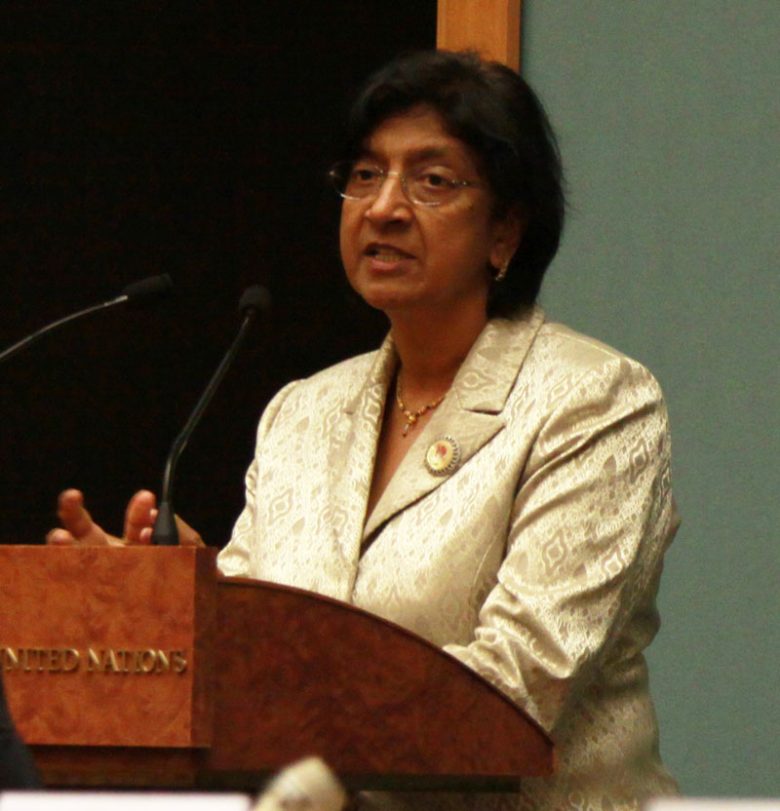
- Lead. Navi Pillay, the South African jurist and former UN High Commissioner for Human Rights, has been awarded the 2026 Nobel Peace Prize, announced in Oslo on Friday.
- Fact. The Norwegian Nobel Committee cited Pillay’s “tireless efforts to promote peace and international law,” spanning anti-apartheid activism, service on the Rwanda genocide tribunal, and her recent leadership of the UN independent commission that concluded Israel had committed genocide against Palestinians in Gaza.
- Stake. The award arrives at a moment of acute strain on international law institutions, with the Gaza commission’s genocide findings rejected by Israel and the United States and the International Criminal Court’s authority challenged on multiple fronts.
The Norwegian Nobel Committee announced on 9 October 2026 that Pillay, 82, would receive the prize. The Committee’s citation praised her “steadfast, independent voice of justice across six decades,” from her early resistance to apartheid in South Africa to her tenure as UN High Commissioner from 2008 to 2014.
A Career Built in Courtrooms and Crisis Zones
Pillay was born in Durban in 1941 and grew up under apartheid, studying law at a time when Black South Africans had near-total barriers to the profession. She became one of the first Black women to open a law practice in South Africa, representing political prisoners including those charged under apartheid’s security statutes. After the transition to democracy she served as a High Court judge and then accepted appointment to the International Criminal Tribunal for Rwanda, where she sat as a judge for nine years and helped shape early jurisprudence on sexual violence as a tool of genocide.
In 2007, the UN General Assembly elected her as a judge on the International Court of Justice before she took up the High Commissioner role the following year. Her two terms at OHCHR were marked by outspoken criticism of Sri Lanka during its final military campaign against the Tamil Tigers, of China’s treatment of minorities, and of the drone programme carried out by the United States. Those positions generated friction with permanent members of the Security Council, and some observers credited them with energising human rights bodies that often tread carefully around powerful states.
The Gaza Commission and Its Fallout
After leaving the High Commissioner’s office, Pillay accepted appointment as chair of the UN Human Rights Council’s independent international commission of inquiry on the Occupied Palestinian Territory and Israel. The commission’s 2024 report concluded that Israel bore responsibility for crimes against humanity; a later report, published in 2025, used the term genocide in describing Israeli military conduct in Gaza. Israel and the United States rejected the findings, and the latter moved to cut funding to the Human Rights Council for the second time in a decade. The Nobel Committee, whose decisions are governed by Alfred Nobel’s will and Norwegian parliamentary tradition, noted that Pillay had maintained the commission’s independence in the face of “intense political pressure.”
The award is not without its critics. Israeli officials responded that the Committee had “turned the Nobel Peace Prize into a political instrument,” while several Western governments expressed discomfort. UN Secretary-General António Guterres praised Pillay as “a steadfast, independent voice of justice whose work has helped establish accountability as a cornerstone of lasting peace.”
Ceremony and Prize
Pillay will receive the Nobel Peace Prize medal and diploma at a ceremony in Oslo on 10 December 2026, alongside the prize sum of 11 million Swedish kronor. She will become only the sixth African recipient of the award since it was established in 1901. Her selection follows a pattern of the Committee recognising human rights lawyers in periods of international legal stress; the growing movement of states imposing trade restrictions on Israeli settlement goods forms part of the wider international law landscape her career helped shape.