
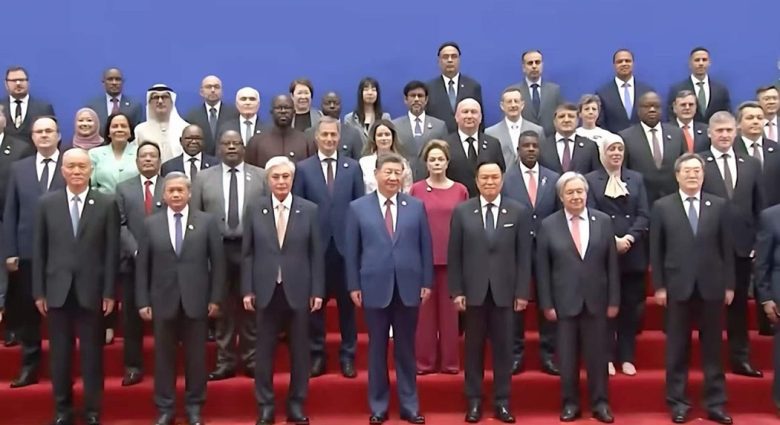
- Lead. China formally established the World Artificial Intelligence Cooperation Organisation (WAICO) on July 16 at the World Artificial Intelligence Conference in Shanghai, drawing 29 founding members — all from the Global South — into a new body for AI governance and standards-setting.
- Fact. Founding members include Indonesia, Brazil, Malaysia, South Africa, Senegal, Russia, and Pakistan; no G7 country joined. Beijing pledged 5,000 AI training slots for participating nations.
- Stake. The launch positions China as an alternative pole in AI governance at a moment when US semiconductor export controls and the EU’s AI Act are shaping the regulatory environment for the technology globally, and when many developing nations feel excluded from that conversation.
Xi Jinping used the WAIC opening session to frame WAICO in terms designed to appeal to nations that see Western technology policy as exclusionary. “AI development should not be a solo performance by a single country, but a symphony of international cooperation,” he said, according to Al Jazeera. He called for opposing the “overstretching of the national security concept” in AI — a pointed reference to US chip export controls that have been progressively tightened since 2022 and now cover a widening range of semiconductor equipment.
Who Joined and Why It Matters
The 29 founding nations represent a significant share of the Global South’s population and data markets, but none are among the technology powers that currently set industry standards. That composition is the point: WAICO is a vehicle for norm-setting at the UN level, where China can muster a bloc of nations behind governance language that differs from the EU’s rights-based regulatory model or the US administration’s security-first framing. Beijing also offered tangible incentives, pledging 5,000 AI training places for engineers and researchers from member states — a capacity-building commitment that gives smaller nations a concrete reason to sign on.
A Counter to Western Frameworks
The launch arrives as the EU AI Act’s penalty powers for general-purpose AI models take effect on August 2, making European AI governance binding on any frontier model deployed in the EU. The US has pursued a different path — export controls on chips rather than model regulation — but both Western approaches share an underlying assumption that AI safety and democratic accountability are the primary organising principles for the technology’s governance. WAICO’s founding documents emphasise equity of access and international cooperation, language that is not inherently incompatible with safety concerns but that de-emphasises the regulatory bite both Western frameworks carry.
China’s AI Position
Beijing’s push to lead global AI governance through WAICO runs alongside its domestic industrial strategy. Chinese frontier models are increasingly trained on domestically produced chips, reducing dependence on restricted Nvidia hardware. Whether WAICO acquires the institutional weight of a body like the IAEA or CERN, or remains a forum without enforcement capacity, will depend on whether member states choose to route binding AI agreements through it or through existing multilateral institutions where Western influence is stronger.