
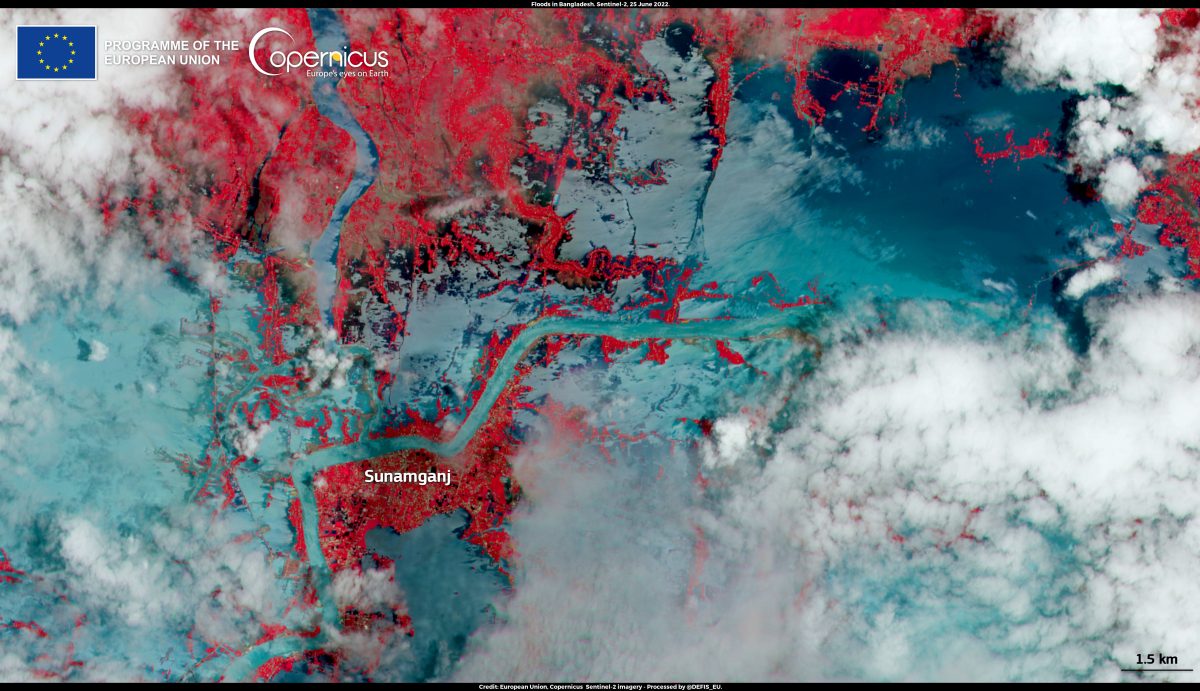
- Lead. At least 59 people have died across seven districts in Bangladesh as the 2026 monsoon season delivers record rainfall, forcing more than 1.28 million people from their homes.
- Fact. Chattogram logged 412mm of rain in a single day on July 7 — the heaviest downpour in 43 years — while August 5 brought 402mm at Dirai in Sunamganj, the worst single-day fall of the year.
- Stake. The World Food Programme faces a $147 million funding shortfall just as international support is shrinking, leaving roughly one million Rohingya refugees in Cox’s Bazar with diminished shelter protection during peak flood weeks.
Bangladesh’s 2026 monsoon season has turned catastrophic. As of late July, flooding and landslides had killed at least 59 people across Chattogram, Cox’s Bazar, Bandarban, Rangamati, Khagrachhari, Moulvibazar and Habiganj districts, according to disaster-mapping data compiled by Mappr. Some 1.28 million people are affected nationwide, with 436,000 requiring direct humanitarian assistance and 268,000 households cut off from road and supply-route access.
Rohingya Camps Bear the Worst
The camps of Cox’s Bazar — home to roughly one million Rohingya refugees — absorbed some of the heaviest damage. At least 17 people, mostly children, died inside the camps. More than 5,000 shelters were destroyed or damaged, and authorities relocated over 20,000 refugees from exposed hillside positions. UNHCR had warned before the season that funding cuts had directly undermined slope-stabilisation work in the camps, stating that reduced support had “heightened the monsoon risk” for the most vulnerable residents. The 2026 humanitarian appeal for Bangladesh is 26% smaller than its 2025 equivalent, and the WFP alone faces a $147 million shortfall.
Record Rainfall, Deep Agricultural Losses
July as a whole was 35.6% wetter than the historical average, recording 666mm against a norm of 457mm. At least 114,723 hectares of cropland have been affected, with an estimated 134,000 tonnes of crops destroyed and losses valued at approximately Tk 478 crore ($43 million). Livestock deaths in Chattogram region alone reached 161,394 animals. Rivers remain elevated: the Teesta is at its warning level at four gauging stations and, along with the Brahmaputra and Jamuna, has been on a steady five-day rise. Upstream in Assam — whose runoff feeds the Bangladesh river system — the season’s toll had reached 82 deaths with roughly 193,000 people still affected as of 1 August.
A Compounding Crisis
Bangladesh’s floods arrive as global humanitarian budgets face sustained pressure. International donors have reduced commitments across multiple South Asia response plans in 2026, a trend that UNHCR and WFP officials say is now directly visible in their operational capacity on the ground. With peak monsoon weeks typically falling in August and September, relief organisations warn the human and agricultural toll is likely to grow before the season ends.