
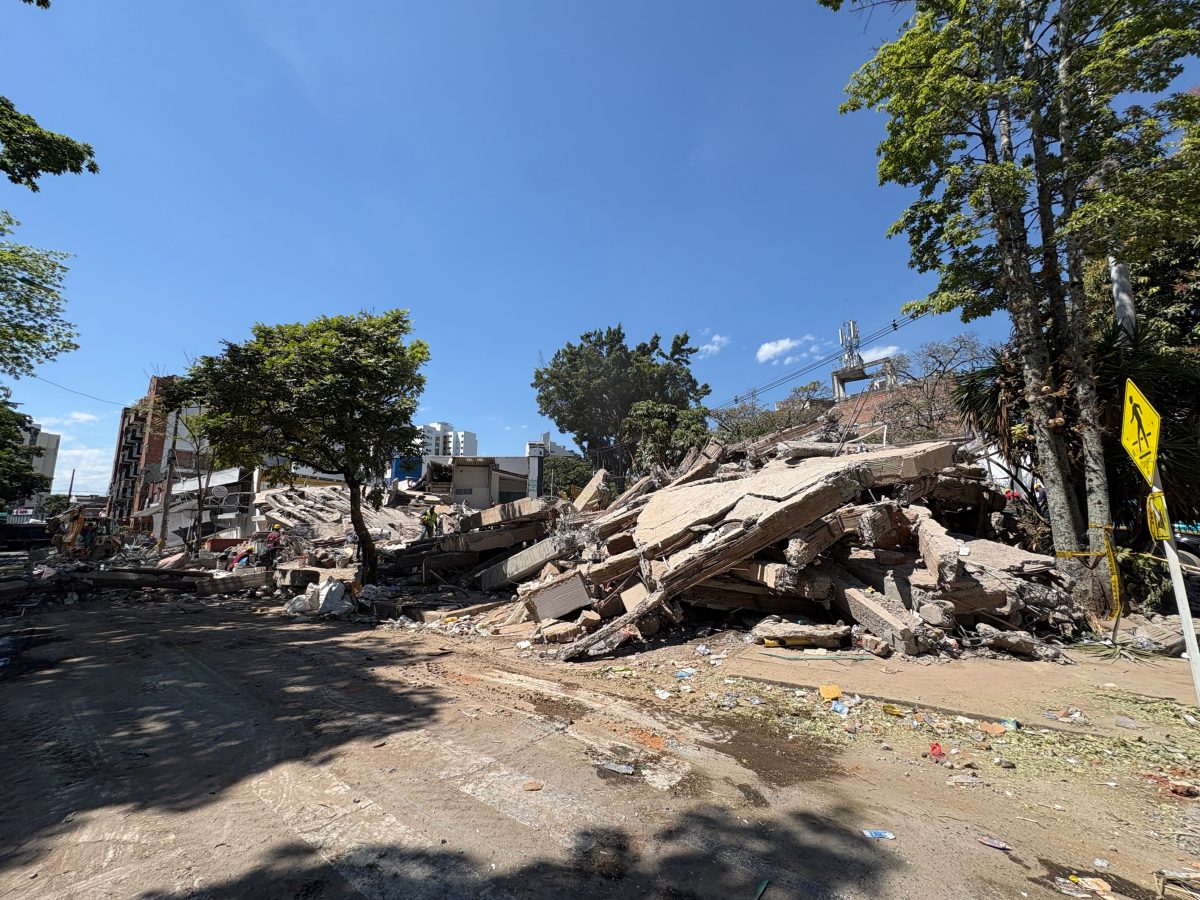
- Lead. A 7.4 magnitude earthquake struck western Colombia on August 11, killing at least 265 people and injuring 2,595 more — the country’s strongest seismic event since 1906.
- Fact. President Abelardo de la Espriella, barely three days into office, declared a national emergency and pledged rent subsidies for displaced families, placing an immediate stress test on his new government.
- Stake. At least 195 people are officially listed as missing, though civilian tracking databases place that figure near 4,000, leaving rescue teams in a narrowing window as aftershocks continue to destabilise debris fields across three major cities.
The earthquake struck at 7:34 a.m. local time near San José del Palmar in the Chocó region, roughly 150 miles west of Bogotá. Shockwaves reached Panama, Venezuela, Ecuador, and Peru, but their most destructive force was concentrated in Cali, Pereira, and Manizales — where the Hospital Universitario del Valle partially collapsed and entire neighbourhoods were flattened. By Wednesday evening, de la Espriella’s office confirmed the death toll at 265, with 2,595 injured and the National Unit for Disaster Risk Management (UNGRD) warning that rural data from cut-off villages in Chocó was still being compiled.
A New President, an Immediate Crisis
De la Espriella had taken office after one of the tightest runoff elections in Colombia’s history, and the earthquake gave him no transition period before crisis management began. His government declared a state of emergency within hours, mobilised the UNGRD, and announced a rent subsidy programme for families who lost homes. Colombia lowered flags at official buildings and embassies worldwide and observed three days of national mourning.
Geological agencies catalogued more than 100 aftershocks by Tuesday afternoon. Roads, tunnels, and bridges connecting the affected departments to Bogotá and port cities were disrupted, complicating the flow of heavy equipment and supplies into the mountainous Chocó — a region that already has among Colombia’s weakest infrastructure.
International Assistance
The United States pledged $15.5 million in emergency funding and deployed urban search-and-rescue teams from Virginia and California. The European Union committed €2.3 million. Mexico sent hundreds of rescue workers and health professionals, and El Salvador dispatched two aircraft carrying 100 tonnes of relief supplies. Teams on the ground used cranes, sniffer dogs, heavy machinery, and volunteers forming human chains to clear collapsed concrete.
The Missing-Persons Gap
The official missing count of 195 stands in sharp contrast to the roughly 4,000 people flagged across civilian family-tracing databases. Relief coordinators attribute the gap to destroyed mobile networks in rural Chocó, roads that remain impassable, and the lag in registering casualties from the smallest municipalities. The UNGRD acknowledged on August 12 that the overall picture was still incomplete — meaning the confirmed death toll of 265 is unlikely to be the final figure.