
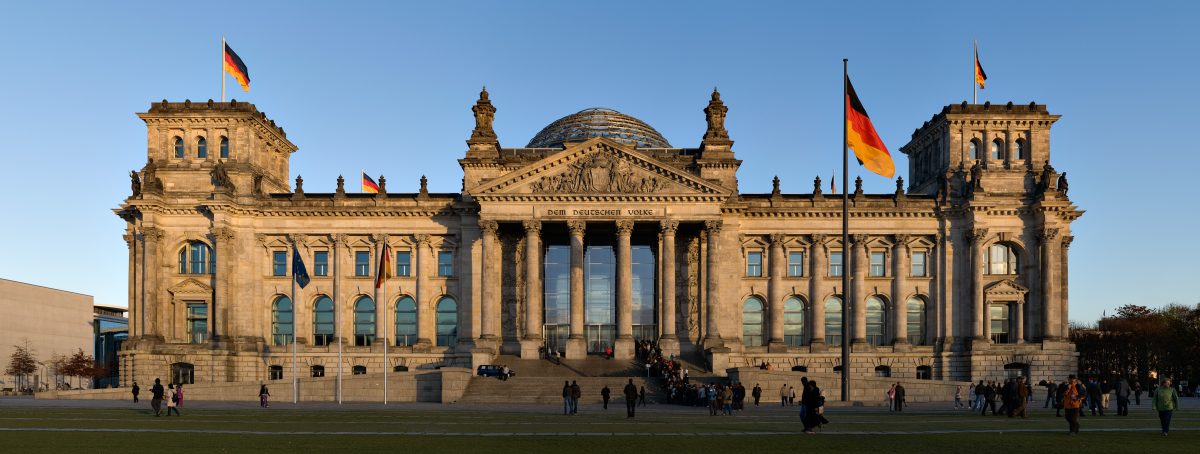
- Split verdict. Germany held two state elections on 20 September producing diametrically opposite winners: the far-left Die Linke took first place in Berlin and the far-right AfD secured its second consecutive state victory in Mecklenburg-Western Pomerania.
- CDU collapse. Chancellor Friedrich Merz’s Christian Democrats fell below the 5 percent parliamentary threshold in Mecklenburg — the party’s worst result in 81 years — and finished second in Berlin with just 18.8 percent.
- Leadership crisis. With federal approval ratings at 14 percent, Merz faces mounting internal pressure as the political space he was elected to occupy shrinks from both directions.
Die Linke’s Elif Eralp led her party to 25.7 percent in Berlin, the first first-place finish for a far-left party in the German capital since reunification in 1990. The CDU finished second with 18.8 percent, the Greens took 14.3 percent, and the SPD — once the city’s dominant political force — recorded its worst-ever Berlin result at 12.1 percent, leaving coalition arithmetic unsettled. The AfD finished third in Berlin with 16.3 percent.
“In our city, love and justice have triumphed over hatred,” Eralp told supporters after results were confirmed on Sunday night — a statement aimed directly at the AfD’s sustained strength in Germany’s east.
Mecklenburg: AfD’s Second Consecutive State Win
In Mecklenburg-Western Pomerania, the AfD secured 38.2 percent of the vote, its second state win in two consecutive weekends following its victory in Saxony-Anhalt on September 7, where it had taken 43.8 percent. The SPD finished second in Mecklenburg at 35.5 percent, meaning a two-party arrangement is arithmetically possible but politically complex given the parties’ national positioning.
The headline number, however, was the CDU’s 4.9 percent — below the 5 percent threshold that grants parliamentary representation and the worst result in the party’s 81-year history at any level of government. The CDU has governed as the dominant centre-right force since the Federal Republic’s founding; Sunday’s figures suggest that dominance no longer extends across significant portions of the former East Germany.
Merz Calls Results a ‘Disaster’
Speaking at CDU headquarters on Sunday night, Chancellor Merz described the combined results as a “disaster.” He called for “backbone, steadfastness, and patience” — language that read more as an appeal to his party’s rank and file than a message of policy correction directed at voters.
Merz came to power promising tighter migration controls and fiscal discipline. His government has struggled to deliver either while managing ongoing military support for Ukraine, elevated energy costs, and a parliament divided among seven meaningful blocs. His 14 percent approval rating sits among the lowest recorded for a German chancellor in the post-war era.
Germany’s political map is fragmenting along lines that offer no conventional remedy. The AfD commanding 35 to 40 percent across large parts of the east, Die Linke reviving in the urban west, and the SPD collapsing in traditional strongholds leaves the mainstream centre squeezed from multiple directions. There is no obvious electoral mathematics that returns the CDU to dominance in the eastern states before the next federal election, which must be held by autumn 2028.