
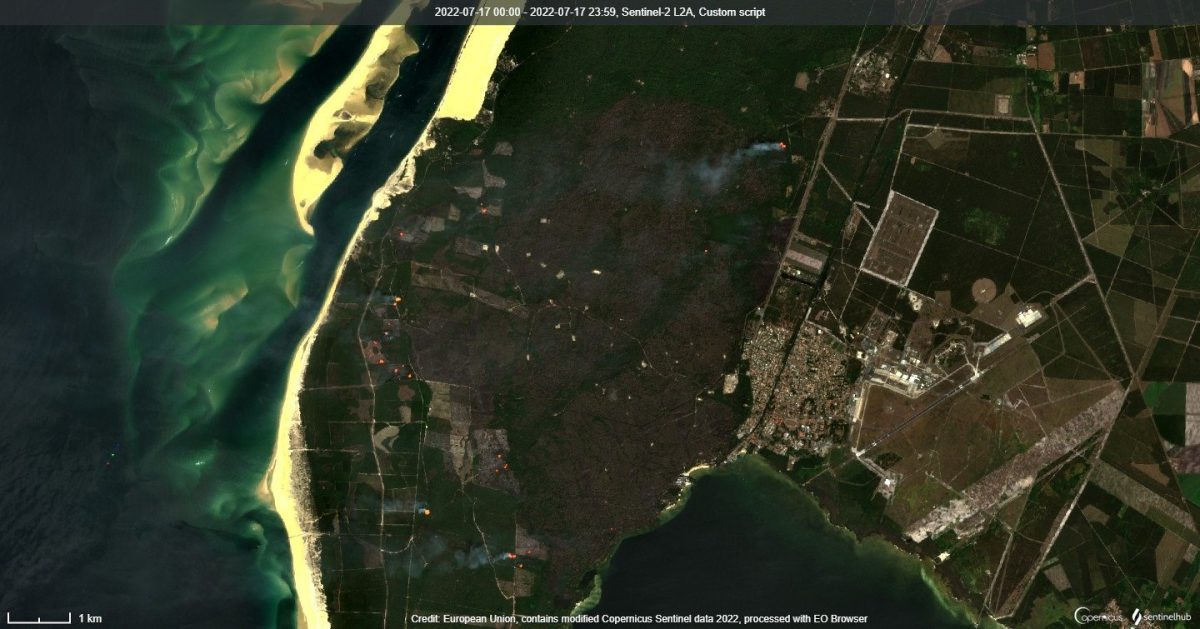
- Lead. The Gironde wildfire in southwest France burned past 42,000 hectares by July 27 — the country’s largest single blaze since the Second World War — forcing 40,000 people to flee the Cap Ferret peninsula and pushing France’s national evacuation total to 250,000.
- Fact. The fire generated a pyrocumulonimbus cloud system — a rare atmospheric event where the blaze produces its own convective thunderstorm — spreading fire-driven lightning to new locations and described by meteorologists as unprecedented in French history.
- Stake. France activated the EU Civil Protection Mechanism, drawing firefighting aircraft from Croatia, Germany, Portugal, Romania, Sweden, and Turkey, while the disaster’s scale forced Tour de France organisers to shorten the race’s final stage on July 27 as Paris police were redeployed.
Southwest France was burning on multiple fronts by the end of July 27. The Gironde fire, centred in the pine forests of the Arcachon basin south of Bordeaux, had consumed more than 42,000 hectares, a figure that civil protection authorities confirmed makes it the largest single wildfire in France since 1945. The national season total, counting all active fire zones, reached 115,000 hectares. Ten deaths and the destruction of at least 240 structures have been confirmed across the outbreak.
A Fire That Builds Its Own Weather
The most alarming development was atmospheric. The Gironde blaze produced a pyrocumulonimbus cloud — a convective column in which the fire’s intense heat creates its own thunderstorm system. Internal temperatures in such columns can reach 1,000°C, generating updrafts strong enough to produce lightning and scatter burning debris kilometres beyond the fire’s established perimeter. Meteorologists described its formation over France as an extremely rare event with no modern domestic precedent, complicating aerial suppression efforts and allowing the fire to leap containment lines during the afternoon of July 26.
Between 30 and 40 separate fires were burning simultaneously across France and Spain on July 26, overwhelming regional coordination. In France alone, evacuations in the Gironde concentrated heavily on the Cap Ferret peninsula, a narrow spit separating the Bassin d’Arcachon from the Atlantic, where 40,000 residents and tourists were ordered to leave. The national total of displaced people reached 250,000.
EU Mechanism Triggered as Forces Stretch Thin
France invoked the EU Civil Protection Mechanism, a mutual-aid instrument that allows member states to request emergency assets from across the bloc. Aircraft and ground crews from Croatia, Germany, Portugal, Romania, Sweden, and Turkey were dispatched in response. The mobilisation underscored the degree to which French civil protection resources were stretched: simultaneously managing multi-front suppression operations, coastal evacuations, and the security demands of major public events.
The Tour de France, whose final stage was scheduled for July 27, was shortened after Paris police and emergency personnel were redeployed to wildfire response — the first time in the modern era of the race that a domestic civilian emergency has forced a route alteration. French Interior Ministry officials described the redeployment as necessary given simultaneous operational demands across multiple regions.
A Season That Broke Records Early
The 2026 fire season arrived earlier and burned hotter than the historical average for the region. Prolonged drought through June, above-average July temperatures, and sustained easterly winds created conditions that fire ecologists had flagged as extreme well before the Gironde ignition. The 2022 season — itself a record at the time — burned roughly 72,000 hectares across France; this year’s total had already surpassed 115,000 by late July, with weeks of peak fire season remaining.