
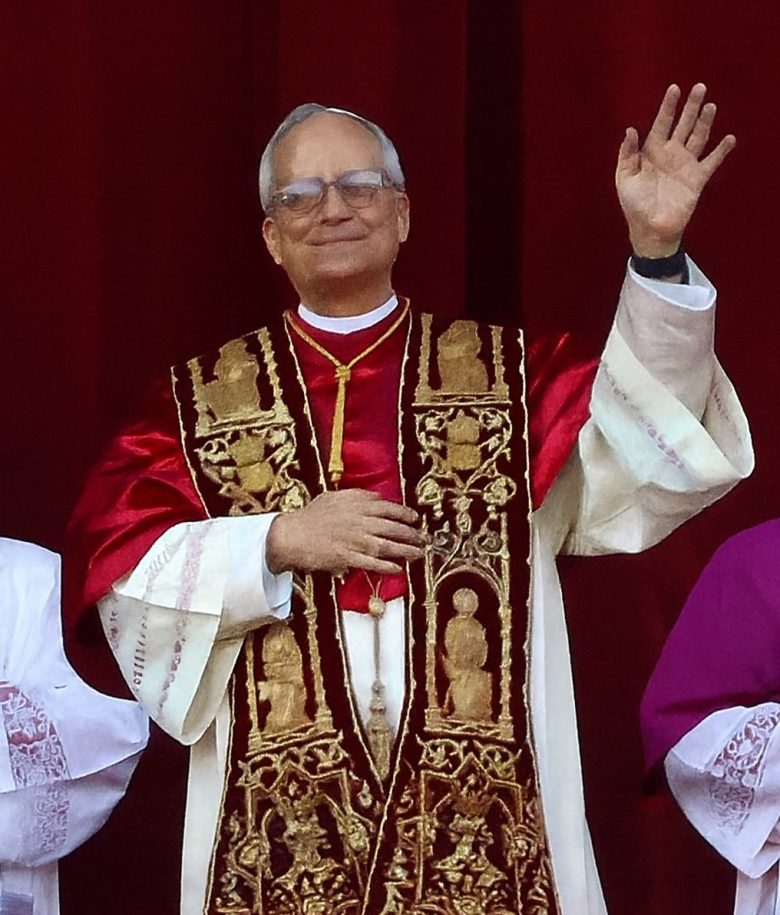
- Warning. Pope Leo XIV opened his France visit on September 26 by telling diplomats and UNESCO staff that artificial intelligence risks creating a “paradise of machines” that strips people of their dignity.
- Nuclear. He called the doctrine of nuclear deterrence “mistaken,” saying it fuels an arms race rather than preventing one — a direct challenge to the strategic logic of France’s own nuclear arsenal.
- Stakes. As the first American-born pope, Leo XIV is emerging as a high-profile voice on two converging threats — AI and nuclear proliferation — at a moment when both are accelerating.
Pope Leo XIV arrived in Paris on Friday for a four-day state visit, delivering his opening address first to President Emmanuel Macron at the Élysée Palace and then to diplomats and United Nations staff at UNESCO headquarters, where he outlined the Vatican’s evolving position on the technologies reshaping the century.
The Machine Question
Speaking at UNESCO, Leo raised the paradox at the heart of contemporary AI development: that computational systems are described as possessing “intelligence” while “we struggle to recognise the inalienable dignity of human persons.” His concern was not that AI is inherently malign, but that the pace of its deployment outstrips the ethical frameworks needed to govern it. “If we are to avoid losing our humanity amid a ‘paradise of machines’ invading and conditioning our daily lives,” he said, “there is an urgent need for education in ethical discernment.” He called on AI developers to place the common good above profit and said the Vatican was seeking direct dialogue with technology companies — following similar outreach begun under his predecessor.
Nuclear Deterrence as Error
On arms control, Leo was unusually direct. Reaffirming the Vatican’s opposition to nuclear weapons, he said deterrence theory was not a stable foundation for peace but a doctrine that was simply “fuelling a new arms race.” His formulation — “Peace is not a balance of power; rather, it is built day by day through dialogue and justice” — carried pointed relevance for France, the only EU member state with an independent nuclear capability, and for the broader NATO alliance whose extended deterrence posture covers Ukraine and the Baltic states. The speech made no explicit reference to the ongoing US-Iran military standoff in the Strait of Hormuz or to Russia’s war in Ukraine, though both conflicts loomed over the diplomatic audience.
Human Rights and French Law
Leo also used the France visit to push back on two recent changes to French law. He reiterated the Vatican’s position that the right to life is the “indispensable foundation of every other human right,” a formulation that signals opposition to France’s 2024 constitutional provision protecting abortion access and to legislation legalising assisted dying that entered force this year. His tone was measured rather than confrontational — he praised France’s tradition of human rights law — but the substantive challenge was clear.
The visit continues through Monday with masses in Lyon and Marseille. It is Leo’s first trip to a major Western European country since his election in May 2025 and his first to a nuclear-armed state. A stop at Notre-Dame for evening prayer capped the opening day, less than seven years after the 2019 fire gutted the cathedral’s roof and spire. While security partnerships are reshaping the Arctic, Leo’s Paris message was that the more consequential reshaping is happening in the labs and arsenals of AI-era states — and that neither technology nor deterrence has delivered the stability it promised.