
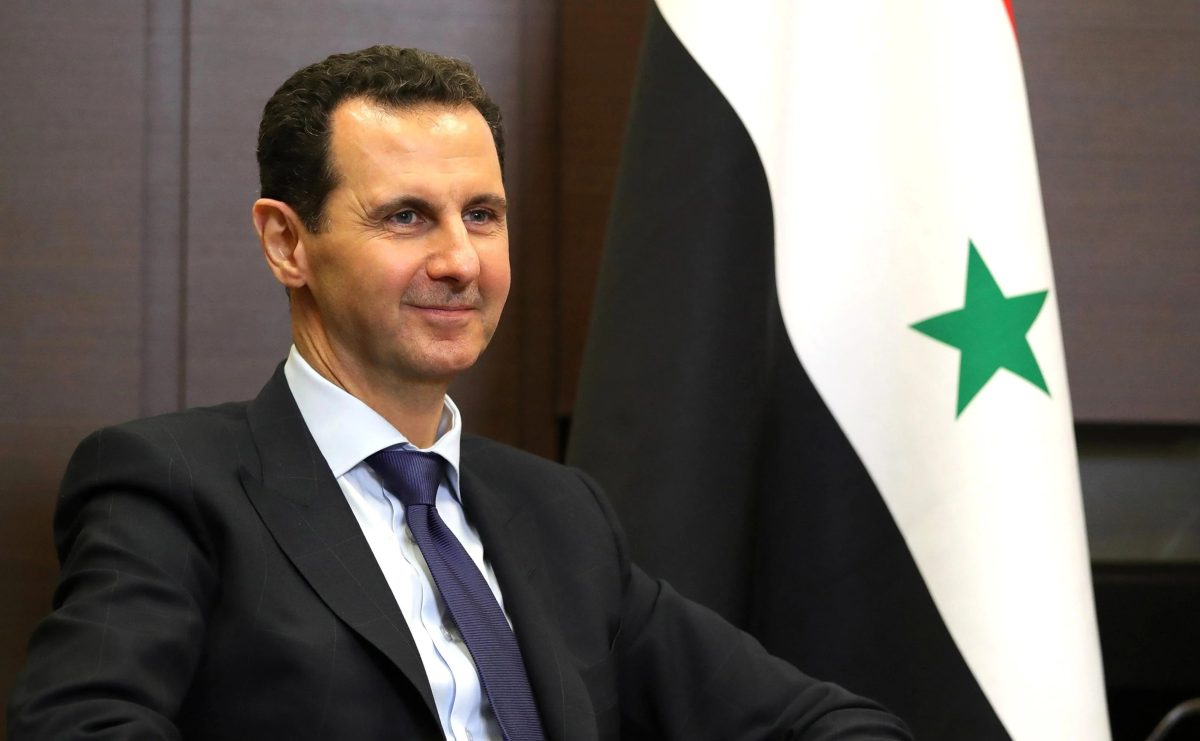
- Lead. Syria’s Fourth Criminal Court in Damascus sentenced former president Bashar al-Assad to death in absentia on August 11, marking the first criminal verdict against Assad or his inner circle since the family’s five-decade rule collapsed in December 2024.
- Fact. Assad’s cousin Atef Najib — the official who launched the crackdown on protesters in Deraa in 2011 that ignited the civil war — was physically present in court, standing in a cage in a prisoner’s uniform when the sentence was read.
- Stake. The sentences are largely symbolic: Assad and his brother Maher remain in Russia under political asylum, and Moscow has refused Syria’s repeated extradition requests. But the verdict establishes a legal record of accountability that Syrian transitional authorities say is foundational to the country’s reconstruction.
The ruling — the first issued by Syria’s transitional justice authorities against former regime leaders — came after proceedings at the Fourth Criminal Court in Damascus that examined testimony about the scale and character of the atrocities committed during the country’s 14-year civil war. The presiding judge, Fakhr al-Din al-Aryan, found that witness testimony established Assad’s role as “the highest decision-maker” in the crimes and that he “used state institutions to facilitate their commission.”
Bashar al-Assad was convicted of premeditated murder, torture, and crimes against humanity. His younger brother Maher al-Assad was sentenced in absentia on premeditated murder and torture charges. Defence Minister Fahd al-Freij and military intelligence chief in Deraa, Louay al-Ali, were also sentenced to death in absentia.
The Cousin in the Cage
The most striking element of the hearing was the presence of Atef Najib, Assad’s maternal cousin and former head of political security in Deraa province. Najib, arrested in January 2025 after the regime’s collapse, stood inside a cage in the courtroom wearing a prisoner’s uniform as the judge read the verdict. He was convicted of crimes against humanity — including murder, what the court described as “the intentional killing of children under 15,” and “torture leading to death.” The judge noted that Najib “denied the charges against him and showed no remorse.”
Najib’s historical significance to the case is substantial. In 2011, he ordered the arrest and torture of teenagers who had written anti-government graffiti in Deraa — an act widely credited with triggering the protests that escalated into one of the most destructive conflicts of the 21st century, killing an estimated half a million people and displacing millions more.
Russia’s Refusal
The practical enforceability of the Assad sentences remains near zero. Both Bashar and Maher al-Assad are living in Russia under political asylum granted by Moscow. Syria’s transitional government has made formal extradition requests; Russia has declined. An Al Jazeera correspondent reporting from Damascus assessed that a reversal was unlikely “barring a major political breakthrough between the two countries” — a formulation that, given current Syrian-Russian relations, amounts to an indefinite deferral.
A crowd gathered outside the Damascus courthouse after the verdict. Many held photographs of torture victims and those killed during the civil war. Al Jazeera’s correspondent Obaida Hitto reported that the ruling was expected to “bring a lot of relief to the Syrian people” and contribute to their “healing process,” while noting that Syrians are seeking accountability not only for Assad but for “the executioners” — those who carried out the regime’s orders at every level of the security apparatus.
Historic but Limited
The August 11 verdict is the first major act of transitional justice in Syria’s post-Assad era. It establishes a formal legal finding — with named defendants, specific charges, and a judicial record — that the Assad government bore criminal responsibility for atrocities committed during the civil war. That record has potential significance for international legal proceedings, reparations frameworks, and the eventual return and resettlement of refugees who fled the conflict.
Whether it translates into actual punishment for the surviving defendants depends on diplomatic developments entirely outside the Damascus court’s jurisdiction. The sentences are both a landmark and a reminder of how far Syria’s transitional justice process still has to travel.