
- Lead. Brent crude closed above $105 a barrel and WTI settled near $93.16 on October 12, as Houthi ballistic missile attacks on Riyadh’s King Khalid International Airport — their third consecutive day of strikes — amplified Middle East supply fears.
- Fact. The US Dollar Index (DXY) rose to approximately 102.58, its highest since April 2025, while the Philadelphia Semiconductor Index dropped 2.67 percent and the Nasdaq composite fell 0.44 percent on chip-sector weakness.
- Stake. The simultaneous rise in crude and the dollar — unusual in normal risk cycles — reflects a geopolitical premium rather than a standard rotation, pointing to structurally elevated energy inflation ahead of US CPI data expected later this week.
Oil led commodity markets on Monday as traders priced in mounting Middle East supply risk. WTI crude rose 1.43 percent to $93.16 a barrel, and Brent climbed above $105, supported by reports of Houthi missile strikes on King Khalid International Airport in Riyadh — the third consecutive day of attacks on the Saudi capital’s aviation infrastructure — as well as persistent tensions around the Strait of Hormuz, according to Mitrade. The Strait, through which roughly 20 percent of globally traded oil flows, has been a flashpoint since the US-Israel strikes on Iran in February.
Dollar Strength Pressures Gold
The Dollar Index’s move to 102.58 — its highest since April 2025 — reflected safe-haven demand alongside expectations that Federal Reserve policy will remain restrictive. Cleveland Fed President Beth Hammack said this week that rates may need to move higher before the inflation outlook improves, reinforcing bets that the Fed’s benchmark, currently at 3.75–4 percent, will stay elevated through at least mid-2027. Gold, which typically moves inversely to the dollar, eased to around $4,171 an ounce — down 0.54 percent — despite the geopolitical backdrop. The 10-year US Treasury yield was quoted near 5.24 percent, adding to the cost of holding non-yielding assets. Trump’s earlier arrangement to allow Russian diesel onto global markets offered some marginal relief to refined-fuel prices but has not reduced the geopolitical premium on crude.
Equities Split Along Sector Lines
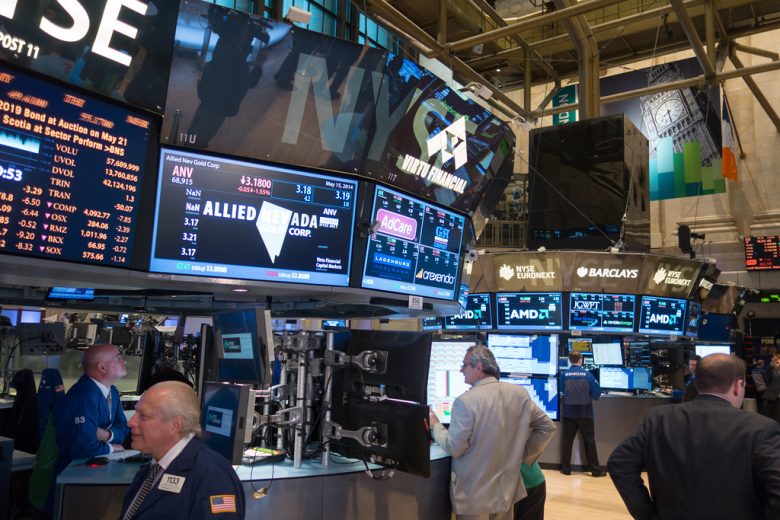
Stock markets diverged. The Dow Jones Industrial Average edged up 0.38 percent to 51,850.55, driven by financial and industrial names, while the S&P 500 dipped 0.06 percent to 7,807.24 and the Nasdaq composite fell 0.44 percent to 27,245.90 on semiconductor weakness. Nvidia fell 1.3 percent and the Philadelphia Semiconductor Index dropped 2.67 percent overall, reflecting continued concern about AI infrastructure spending and chip financing. Meta was a notable gainer, rising 3.4 percent. Bitcoin recovered, rising 2.28 percent to 83,614. Markets were positioned cautiously ahead of the IMF’s October World Economic Outlook, which on Tuesday raised 2026 global growth to 3.1 percent but warned that energy inflation had risen to 4.7 percent.