
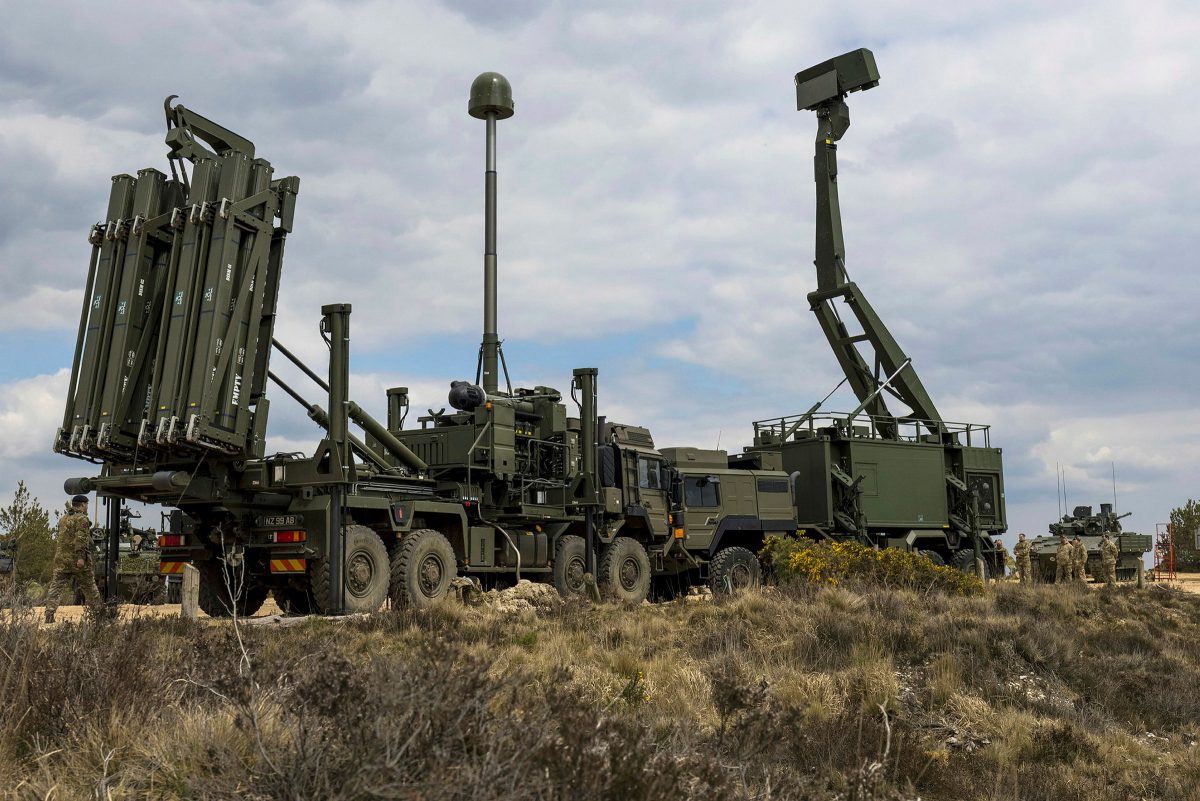
- Lead. The UK Ministry of Defence has awarded preliminary contracts for Project Nightfall — Britain’s first home-built ballistic missile since the 1970s — with the weapon explicitly earmarked for Ukraine.
- Fact. The missile carries a 200 kg warhead, has a range of 500 km, and is designed to launch from multiple vehicle platforms in electronically contested environments; a unit cost ceiling of £800,000 (~$674,000) keeps it affordable at scale.
- Stake. The programme is framed as both a near-term battlefield contribution and a longer-term drive to cut European dependence on American-made precision-strike weapons — a priority underscored at last month’s NATO Ankara summit.
Bloomberg reported on July 16 that the MoD has signed contracts with British defence companies for the programme and relaxed the original design specifications to accelerate the timetable. Project Nightfall will be the country’s first domestically developed ballistic missile since the Chevaline upgrade to Polaris in the 1970s and 1980s — a gap of more than five decades.
A Programme Shaped by the Front Line
The operational requirements for Nightfall are drawn almost directly from Ukraine’s battlefield experience. The missile must fire salvos in quick succession and function inside environments saturated with electronic jamming — conditions that Russian forces have refined across three years of war. Range was scaled back from an initial 600-plus kilometres to 500 km to speed development; the warhead was trimmed from 300 kg to 200 kg for the same reason. The MoD expects to conduct test launches within 12 months and to deliver the first systems to Ukraine in late 2027, with a production capacity of up to ten units per month once fully operational.
A parallel programme, Project Brakestop, has been in testing since late 2024 and is developing a lower-cost long-range cruise missile. The two projects together represent the most substantial British investment in sovereign long-range precision strike since the Cold War.
Reducing Dependence on Washington
The dual-purpose framing of Nightfall is explicit. The MoD stated the UK was applying the lessons of Ukraine to deliver military capability faster, using rapid prototyping, innovation and close collaboration with British industry — language that positions the programme as both a contribution to the current war and a model for European sovereign defence capability.
That second goal has acquired urgency since early 2026. The NATO Ankara summit last month locked in a 5% GDP defence spending target and made burden-sharing the centrepiece of the alliance’s forward agenda, with the US signalling that European members must take greater ownership of their own security. Nightfall is a direct response: a domestically manufactured ballistic missile removes one more capability that European allies currently depend on the United States to supply.
The announcement arrives alongside a busy week for western arms flows to Ukraine. Sweden recently confirmed a deal for 16 Gripen E jets alongside a Danish commitment of $670 million in defence aid. Long-range precision strike remains a critical gap for Kyiv’s military, and Nightfall — if it meets its late 2027 delivery target — would arrive during a phase of the conflict where Ukraine’s ability to threaten Russian logistics and production facilities far from the front line has repeatedly shaped the battlefield.