
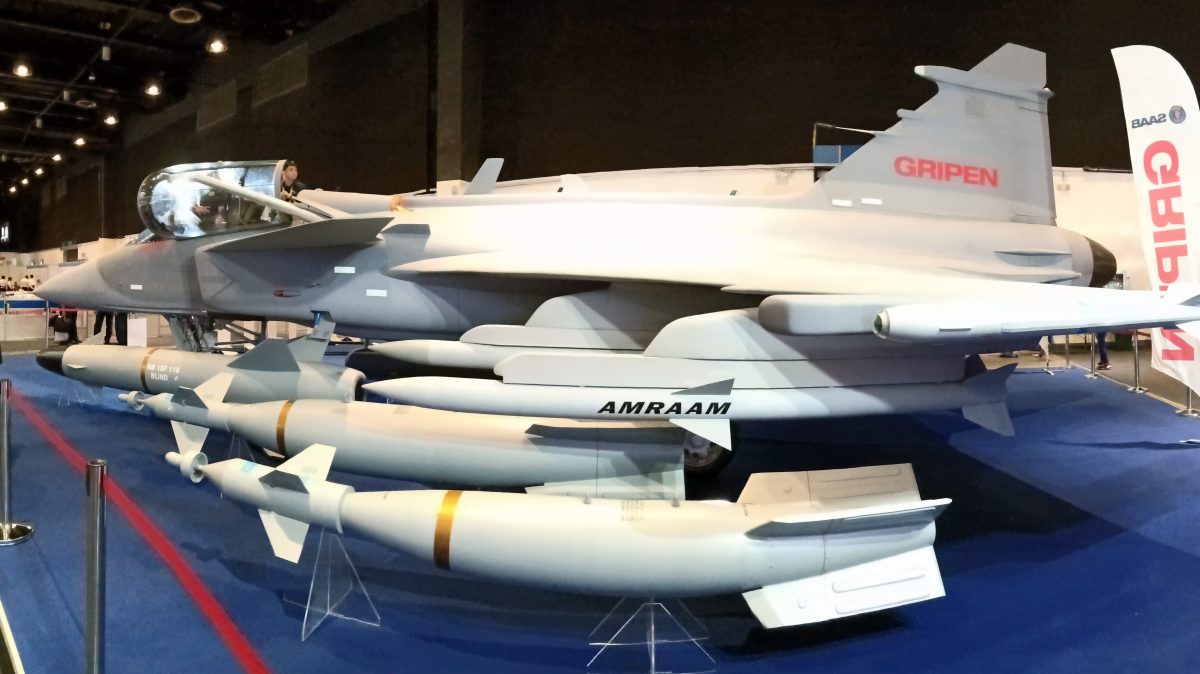
- Lead. Ukraine signed an agreement on 30 June 2026 to purchase 16 Saab JAS-39E Gripen multirole fighters from Sweden, with deliveries beginning in early 2029 — adding a second tranche of the Swedish-designed aircraft to a separate deal for 16 older Gripen C/D jets already expected in early 2027.
- Fact. The deal is financed through a European Union loan with additional support from the United Kingdom, and was signed by Ukraine’s Deputy Minister of Defence Sergiy Boyev and Mikael Granholm, Director General of the Swedish Defence Materiel Administration, in a meeting between President Volodymyr Zelensky and Swedish Defence Minister Pål Jonson.
- Stake. The same day, Denmark announced a separate $670 million defence assistance package, of which approximately $200 million is routed through the “Danish model” — a mechanism that funds Ukrainian arms manufacturers directly rather than supplying weapons from existing inventories.
Why Gripen for Ukraine
The Saab JAS-39 Gripen was designed during the Cold War specifically to operate under conditions of dispersed basing — meaning the aircraft can be maintained and refuelled from roads and motorways rather than requiring intact airbases. That engineering history makes it particularly well suited to Ukraine’s operational environment, where Russian strikes on military airfields have been a persistent threat. The E variant, the most advanced production version of the type, carries updated radar, expanded weapons carriage, and improved electronic warfare systems relative to the C/D aircraft Ukraine is already receiving.
Zelensky stated after the signing: “Together with Sweden, we continue strengthening Ukraine’s combat aviation.” The announcement from the Ukrainian presidency noted that the agreement covers not just the aircraft but a package of related equipment, technical support, and maintenance infrastructure. Sweden has been among the most consistent Western military contributors since Russia’s 2022 invasion, supplying tanks, artillery, armoured vehicles, and reconnaissance aircraft across successive aid tranches.
Denmark’s direct-funding model
Denmark’s $670 million package, announced on the same day, breaks from the conventional aid model. Rather than supplying weapons drawn from Danish military inventories, roughly $200 million is allocated through what Danish officials call the “Danish model” — direct transfers to Ukrainian defence manufacturers. The approach allows Kyiv to commission production runs for weapons it has already integrated into its doctrine, rather than absorbing whatever allied militaries choose to donate. The remaining portion of the $670 million covers more conventional military assistance.
The twin announcements come as Ukraine has been sustaining one of its heaviest long-range drone campaigns against Russian military infrastructure, including a second confirmed strike on Russia’s Dubna space communications centre confirmed by Zelensky in recent days. The tempo of strikes and the concurrent accumulation of higher-capability Western platforms reflect Kyiv’s stated strategy of raising the cost of the war to Moscow while hardening its own military capacity for what its leadership describes as a negotiated conclusion on acceptable terms.
The aviation picture by the numbers
When the Gripen C/D tranche arrives in early 2027 and the E-variant tranche follows in early 2029, Ukraine will have received 32 Swedish-supplied fighters in addition to the F-16s transferred from the Netherlands, Denmark, Belgium, and Norway under separate programmes. Western-supplied combat aircraft have moved from a symbolic aspiration in 2022 to a concrete component of Ukraine’s order of battle, though integrating multiple platform types from different nations simultaneously presents significant logistical and training demands for the Ukrainian Air Force.