
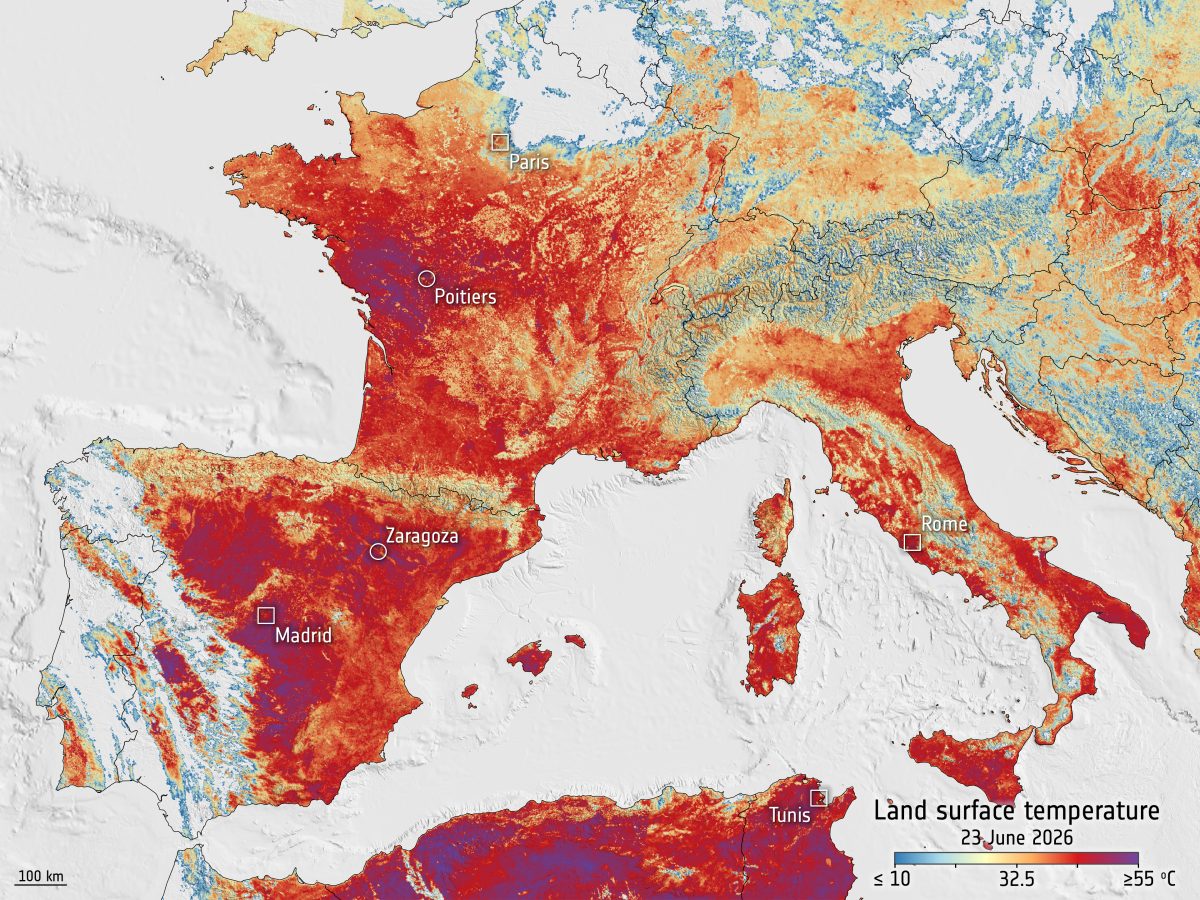
- Lead. Italy’s Health Ministry activated its highest heat warning for all 27 cities under national surveillance on Thursday — a simultaneous maximum alert with no precedent in the network’s history.
- Fact. Austria set a national temperature record of 41.2°C in Bad Deutsch-Altenburg, while Budapest recorded its warmest overnight low ever at 28°C; it is the fourth distinct heatwave to hit Italy since late May 2026.
- Stake. Hungary’s Paks nuclear plant cut output to roughly 10% of normal capacity as its cooling water ran too warm, and critically low river levels disrupted shipping and industrial power use across Central Europe.
A North African anticyclone strengthening over the Mediterranean for more than two weeks pushed ground-level temperatures above 40 degrees Celsius in Italy, Austria, Serbia, and Croatia on Thursday. Italy’s national heat surveillance system — which tracks 27 cities using temperature, humidity, and overnight recovery data — placed every node on red alert simultaneously for the first time, according to a Euronews report citing the Health Ministry’s evening bulletin.
Italy: An Unprecedented Maximum Alert
The Health Ministry in Rome stated the emergency “affects the entire population, not only vulnerable groups,” and instructed hospitals to brace for a higher volume of heat-related admissions. Municipal cooling centres were opened and major tourist sites — including the Colosseum and the Vatican Museums — extended their hours to distribute visitors across cooler parts of the day. Previous heatwaves this summer had placed up to 25 cities on maximum alert; Thursday’s escalation brought the entire surveillance network to red simultaneously for the first time in its operating history.
It is the fourth distinct heatwave Italy has experienced since late May 2026. Climatologists attribute the unusual frequency to a persistent blocking pattern in mid-latitude atmospheric circulation that has repeatedly allowed Saharan air masses to flow northward across the Mediterranean without being displaced by Atlantic fronts.
National Records Broken Across the Continent
Austria recorded a national temperature record of 41.2°C in Bad Deutsch-Altenburg, a Danube river town east of Vienna, on Wednesday. Budapest’s overnight low of 28°C set the Hungarian capital’s warmest-ever nighttime minimum, a significant health indicator because overnight recovery is critical to limiting heat-stress deaths. In southeastern France, a wildfire in the Var département burned more than 60 square kilometres after igniting on July 20 — a blaze that follows France’s Gironde catastrophe earlier in the summer, which burned 42,000 hectares in the country’s worst outbreak since 1945.
Serbia and Croatia reported temperatures approaching 40°C with active wildfire and drought conditions. Austria’s national rainfall has run 27% below the seasonal average in 2026, with some eastern regions recording just half their normal precipitation since January.
Energy and Transport Under Strain
The most immediate economic consequence of the heat appeared in Hungary, where the Paks nuclear power plant — responsible for roughly half the country’s electricity generation — reduced output to approximately 10% of normal capacity after Danube water temperatures rose above the safety threshold for reactor cooling. Germany’s Rhine and other inland waterway networks faced major shipping disruptions for the second time this summer, with freight operators halting traffic on affected stretches. Industrial facilities and heavy transport operators in Central Europe were asked to curtail consumption during peak heat hours between 5 and 10 in the evening.
European meteorological services do not forecast a meaningful break in conditions until late next week, when an Atlantic frontal system is expected to push the anticyclone southward. Health authorities across the continent have urged residents to limit outdoor activity during peak afternoon hours, prioritise hydration, and check on elderly or chronically ill neighbours during the current period.