
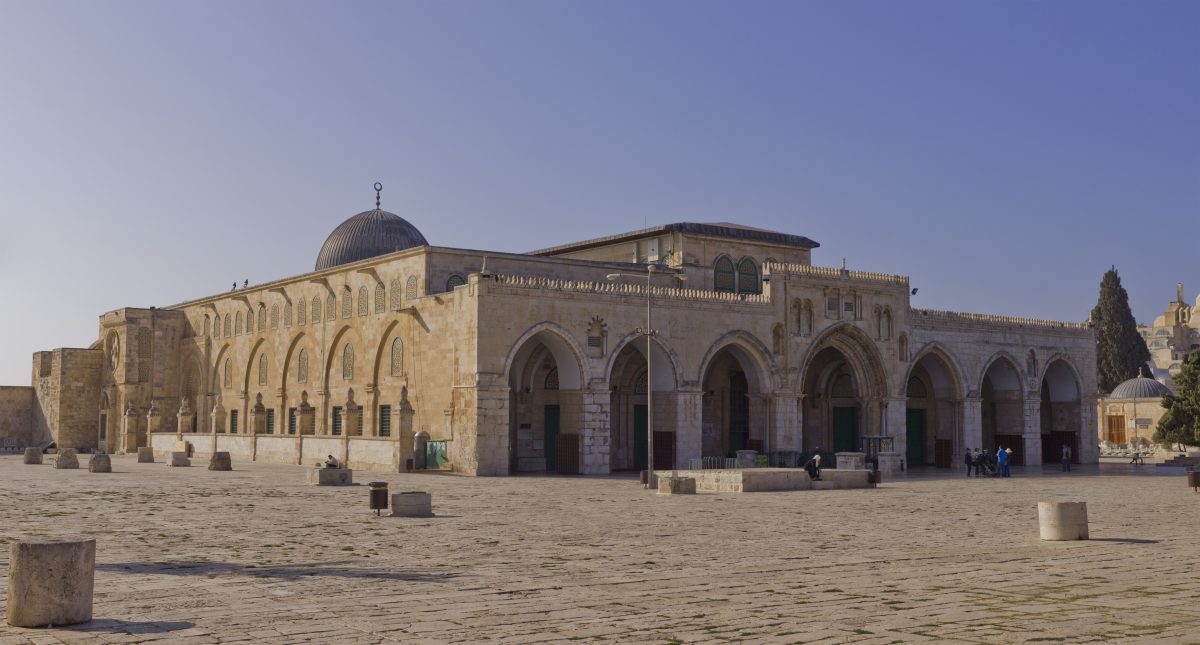
- Lead. Jordan convened an emergency ministerial meeting in Amman on August 5, drawing foreign ministers from the Arab world and Muslim-majority nations to address what it called an imminent Israeli effort to alter the status of the Al-Aqsa Mosque compound in Jerusalem.
- Fact. The trigger was a July 23 incident in which more than 2,000 Israeli nationals, led by far-right National Security Minister Itamar Ben-Gvir, conducted Jewish prayer at the compound in violation of the long-standing status quo reserving worship there for Muslims.
- Stake. The meeting marks the broadest coordinated Arab-Islamic diplomatic mobilisation over Jerusalem in years, and its joint statement explicitly demands UN Security Council action — raising the prospect of a formal resolution attempt.
The Jordanian capital served as the venue for an emergency gathering of the Arab Ministerial Committee in Support of Jerusalem and Its Holy Sites, joined on August 5 by delegations from Türkiye, Indonesia, Malaysia, and Pakistan. Jordanian Foreign Minister Ayman Safadi opened proceedings by asserting that “an occupying power has no sovereignty over occupied territory,” a phrase that set the tone for discussions spanning several hours. Saudi Foreign Minister Prince Faisal bin Farhan argued that “protecting Jerusalem was not only a religious or humanitarian issue, but a fundamental pillar of any just and lasting peace.”
What Drove the Meeting
The July 23 visit by Ben-Gvir and more than 2,000 settlers to the compound — known to Jews as the Temple Mount and to Muslims as the Haram al-Sharif — was condemned by Jordan, the designated custodian of the holy sites, as a deliberate breach of the status quo agreements that have governed access since 1967. Arab League Secretary-General Nabil Fahmy, speaking at the Amman session, warned that extremist settler factions were attempting to reframe the conflict in purely religious terms, and accused the Israeli government of seeking a temporal and spatial division of the mosque’s usage.
Egypt’s Foreign Minister Badr Abdelatty added the weight of Cairo’s voice to the unified appeal, with the meeting’s final communiqué calling on the UN Security Council and the international community to take immediate, binding steps to halt Israeli measures in Jerusalem and across the occupied Palestinian territories.
Regional Backdrop
The Amman session took place against a broader backdrop of continued Israeli military operations in Gaza. The diplomatic flare-up over Al-Aqsa follows Israeli strikes across Gaza’s central corridor, including Bureij and Jabalia, which drew earlier rounds of international condemnation. The intersection of ground operations and pressure on Jerusalem’s holy sites has placed the Hashemite Kingdom in a particularly acute position, given Jordan’s treaty obligations and custodianship role.
No formal Security Council session has yet been scheduled in response to the Amman statement, and Washington’s posture toward Israeli settlement activity at the holy sites remains unclear. What the meeting did establish is a rare formal alignment between Arab states and major Muslim-majority nations outside the region — a coalition that could sustain diplomatic pressure through the UN system into the autumn.