
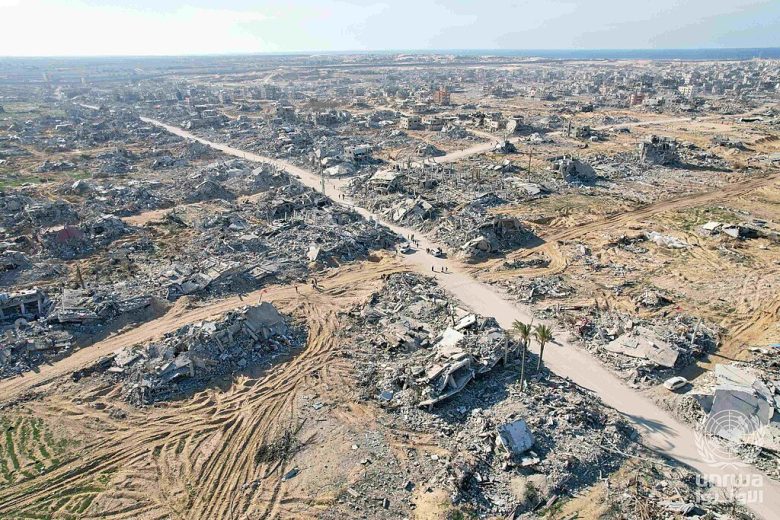
- Lead. The US-led Board of Peace on July 31 announced that Hamas had agreed to a staged disarmament in Gaza, with Egypt, Qatar, and Turkey co-signing a roadmap that would eventually replace Israeli forces with an International Stabilization Force of approximately 5,000 personnel.
- Fact. Hamas negotiator Ghazi Hamad stated that his movement “will not implement any step of the Gaza peace deal if the Israeli occupation forces do not fulfil their obligations” — and as of July 31, Israel had not publicly confirmed it accepted the terms.
- Stake. The agreement sets a 14-day window to finalise a weapons inventory and estimates a 200-to-300-day disarmament process; since the October 2025 ceasefire nominally took hold, at least 1,100 Palestinians have been killed in continued Israeli strikes.
What the deal says
The agreement was announced on the evening of July 30 by President Trump, who said the Board of Peace — a US-led coordination body — had finalised a roadmap with Egyptian, Qatari, and Turkish mediators for what he called a “historic breakthrough” on Hamas disarmament. Under the framework, Hamas would surrender heavy weapons, military infrastructure, and tunnel networks in phases; the precise disarmament schedule must be agreed within 14 days, with possible extensions subject to an international verification body.
Once disarmament is complete, Trump said Israel would withdraw from Gaza and be replaced by the International Stabilization Force working alongside a newly formed Palestinian police force. The overall timeline for full disarmament is estimated at 200 to 300 days, according to the Board of Peace.
Hamas conditions its compliance
Hamas’s public response was guarded. Hamad confirmed the movement had agreed to a detailed roadmap but made compliance explicitly conditional on Israeli behaviour. Non-Hamas armed groups operating in Gaza were not party to the negotiations and their posture toward the disarmament process remains uncertain.
The October 2025 ceasefire, under which the current phase of the conflict has nominally operated, has already seen more than 1,100 Palestinians killed — a figure that shapes Hamas’s willingness to trust verification mechanisms. The movement’s core political problem is that laying down arms before Israeli forces leave exposes it to the military pressure it has survived precisely by maintaining an armed deterrent.
Israel’s silence and the far-right veto
Israel issued no public statement accepting the July 31 framework. The absence of Israeli confirmation is the deal’s central vulnerability: without a formal commitment from Tel Aviv to the withdrawal timeline, Hamas has no binding obligation to begin disarming. Israeli far-right coalition partners have consistently opposed a full Gaza withdrawal, making any Netanyahu government agreement to the terms politically costly at home.
The US ambassador to the United Nations, Mike Waltz, told reporters that Washington was in active talks with both sides to bridge the remaining gaps. Whether those gaps can be closed within the 14-day inventory window will be a crucial early test of whether the announcement holds.
Regional stakes
The four-party mediation structure — US, Egypt, Qatar, Turkey — reflects the breadth of regional engagement required to move Hamas. Qatar hosts the movement’s political leadership; Egypt controls the Rafah crossing and has the deepest operational knowledge of Gaza’s tunnel networks; Turkey has positioned itself as a mediator with both Western credibility and Islamist-movement trust. Their joint endorsement of the roadmap is a genuine diplomatic achievement, even if the outcome remains uncertain.
For Washington, a durable Gaza settlement would remove the most persistent source of friction between the Trump administration’s regional ambitions and its Arab partners. For Hamas, agreeing to a disarmament roadmap — conditional as it is — represents a significant political concession that carries internal risks of its own.