
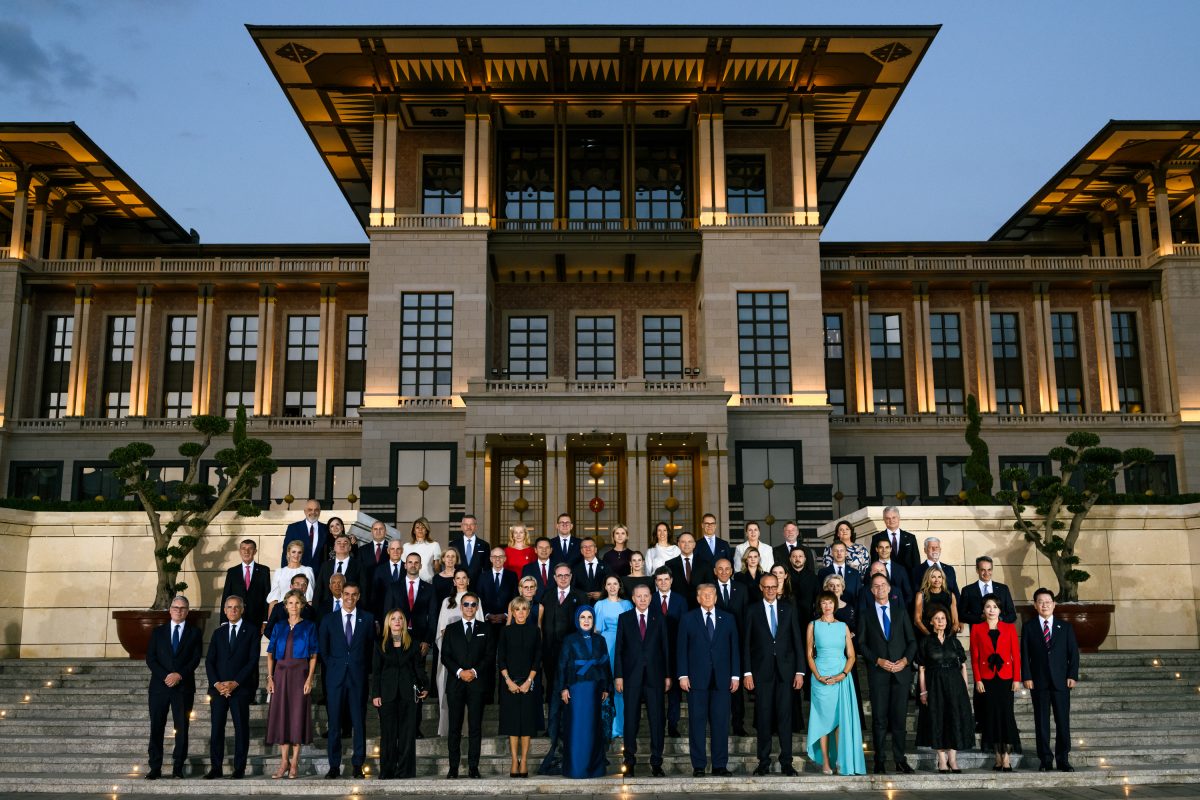
- Lead. NATO’s 36th summit, held in Ankara on 7–8 July 2026, produced a formal pledge of €70 billion in military assistance for Ukraine in 2026 and a commitment to sustain “at least equivalent levels” of support in 2027.
- Fact. For the first time all 32 NATO members met the 2% of GDP benchmark in 2025 — up from just three allies in 2014 — and the Ankara summit formalised the 5% GDP defence-investment target agreed at last year’s Hague gathering.
- Stake. With the United States reducing its rotational troop presence in Europe before the summit, European allies face a widening security burden they are racing to fill through domestic rearmament and industrial commitments.
Heads of state from all 32 NATO member countries convened at Turkey’s Presidential Complex in Ankara on 7 and 8 July 2026 for the alliance’s 36th summit — its second hosted by Turkey since Istanbul in 2004. Ukraine, Australia, Japan, South Korea, Azerbaijan, and delegations from Gulf states attended as non-member guests. Donald Trump represented the United States.
Ukraine’s €70 billion lifeline
The summit’s most concrete output was a pledge of €70 billion in military assistance to Ukraine for 2026. According to diplomats cited in coverage of the gathering, the figure comprises roughly €30 billion drawn from the broader €90 billion international loan facility and approximately €40 billion in bilateral support from European governments — broadly matching current levels but codified without any direct US funding. The text committed allies to “at least equivalent levels” of support in 2027, setting a floor that sidesteps the annual political friction over aid renewal.
The commitment followed a winter in which the United States cut its rotational troop presence in Europe ahead of the summit, intensifying European calculations about what the US security guarantee is now worth. Ukraine’s path to formal NATO membership was not advanced at Ankara, but the scale and duration of the support pledge was framed by officials as a functional substitute for the Article 5 protection membership would confer.
Defence industry moves to the centre
A full day on 7 July was allocated to the NATO Summit Defence Industry Forum — a structural choice that reflected where the alliance’s priorities now sit. Secretary General Mark Rutte opened the forum with a statement that served as the summit’s thesis: “There is no strong defence without a strong defence industry.”
The forum produced a series of capability initiatives: purchase of Triton unmanned surveillance aircraft for allied intelligence, surveillance and reconnaissance; a new critical raw materials project targeting defence supply chain vulnerabilities; investment in high-end space capability; and an expansion of strategic airlift capacity to move troops and materiel across the Atlantic and within Europe. The emphasis on production pipelines and procurement systems, rather than political communiqués, was deliberate.
Five percent, thirty-two members, and the Trump variable
NATO figures published in March showed that all 32 members hit the 2% of GDP defence benchmark in 2025 — a threshold only three allies met in 2014. The Ankara summit held the 5% GDP aspiration steady as a ceiling rather than a hard near-term floor, but with several larger European members now publishing national spending plans that approach it, the target has moved from rhetorical to structural.
Trump’s presence in Ankara shaped the summit’s atmosphere without producing an open rupture. European leaders arrived with the memory of US financial aid to Ukraine having been severed earlier in the year, and with the reduced troop presence already in effect. The private divergences — on relations with China, on the Middle East, on the alliance’s political character — were papered over in the public declarations but acknowledged in briefings. As one senior diplomat put it before the summit: the transatlantic alliance has become “a relationship of unequal interests rather than shared values,” and Ankara crystallised that dynamic without resolving it.