
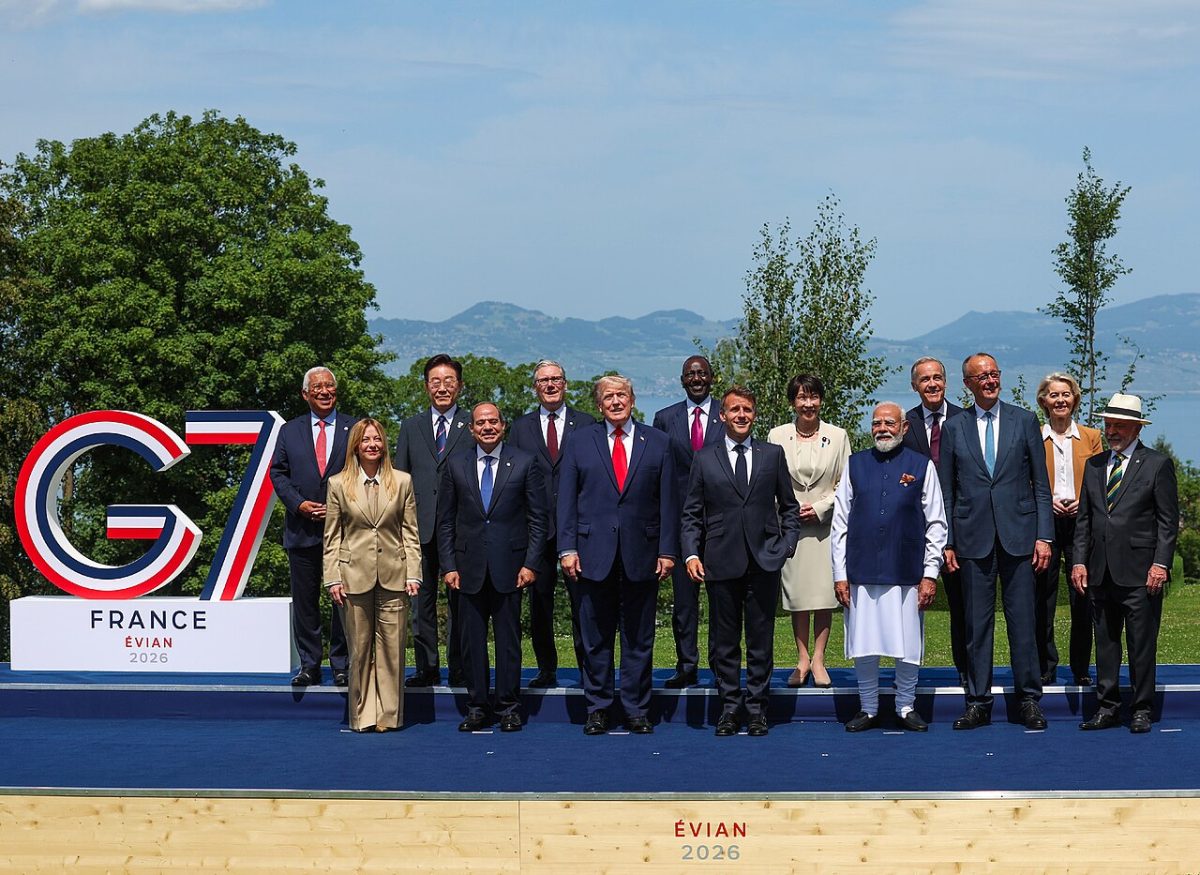
- Lead. The G7 summit in Évian concluded on June 17 without issuing a traditional joint communiqué — the first time in the forum’s modern era — but published nine targeted deliverables, including a fresh commitment to tighten sanctions on Russian oil and gas.
- Fact. Leaders pledged to increase deliveries of air-defence systems, interceptors, and long-range capabilities to Ukraine, and discussed extending manufacturing licences to Kyiv to expand domestic weapons production, according to the formal leaders’ statement published by the Élysée.
- Stake. The absence of a communiqué reflects underlying disagreements, but the agreed package still represents a step-up in pressure on Moscow at a moment when Russia has intensified its aerial campaign against Ukrainian cities and cultural infrastructure.
The 52nd G7 summit, held at the shores of Lake Geneva in Évian, France under French President Emmanuel Macron’s chairmanship, ended on the evening of June 17. The decision to forgo a single communiqué — replaced by nine separate thematic statements — acknowledged the difficulty of achieving full consensus across economic, geopolitical, and development issues at a moment of deep transatlantic policy divergence. Chinese state news agency Xinhua reported the absence of a communiqué prominently, framing it as a sign of G7 fracture.
What leaders actually agreed
The formal leaders’ statement on geopolitical issues committed G7 members to “strengthen our sanctions, including those on the oil and gas sectors” targeting Russia. On Ukraine, the statement pledged to “increase the delivery of air defence capacities, additional systems and interceptors, and long-range capabilities” and to explore extending manufacturing licences to allow Ukraine to produce weapons domestically. Energy resilience — ensuring Ukraine can withstand next winter — also featured as a headline commitment. The summit credited President Trump with securing the Strait of Hormuz deal that has helped lower oil prices and ease inflationary pressure across G7 economies.
Trump’s Russia stance and alliance management
The summit came days after Britain, France and Germany pressed the Trump administration on Ukraine peacekeeping arrangements — a conversation that produced no firm commitment from Washington but kept the issue formally on the table. Trump’s willingness to endorse tighter Russia sanctions in the leaders’ statement was read by European officials as a modest alignment compared to earlier US ambivalence. The broader picture of NATO burden-sharing and peacekeeping contributions remained unresolved, with European members continuing to push for a firmer US commitment to the continent’s eastern flank.
What the absence of a communiqué signals
Analysts close to the summit noted that the shift to thematic deliverables reflects a pragmatic adaptation to a G7 where the risk of a single failed consensus is too politically costly. The nine documents allow each member to highlight areas of agreement without being bound to a single, negotiated text on issues where gaps remain. Whether this format becomes the new norm for multilateral summits — or proves a one-off concession to the current political environment — will become clearer at the next G7 meeting under the incoming Canadian presidency.