
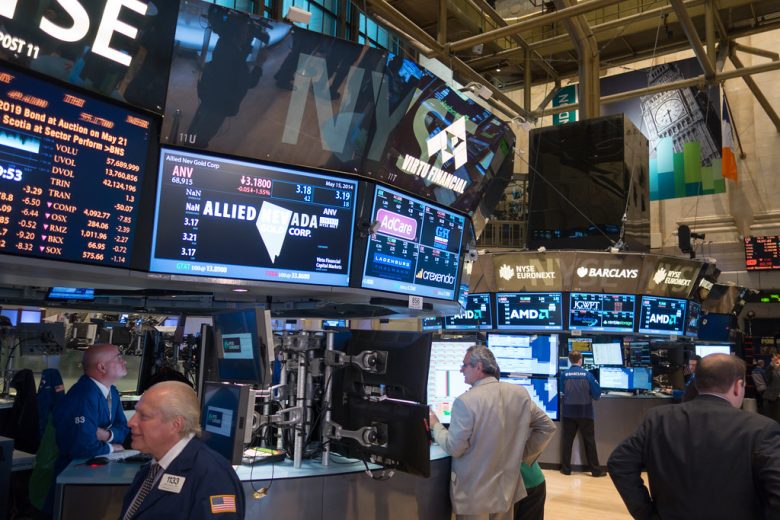
- Lead. The Nasdaq Composite fell 2.49% on Monday and confirmed a correction, now more than 10% below its October 6 record close, as AI-related stocks led a broad retreat across Wall Street.
- Fact. The Philadelphia Semiconductor Index fell 5.3% on the day — cutting its 2026 year-to-date gain to roughly 43% from a June peak of 106.6% — while Intel and Micron each dropped more than 7%.
- Stake. The selloff came on the eve of Nvidia’s quarterly earnings report and ahead of Anthropic’s Nasdaq IPO later this week, leaving two key market catalysts unresolved as sentiment turns.
Semiconductors Bear the Brunt
Wall Street closed sharply lower on Monday as AI-sector anxiety returned with force. The S&P 500 fell 1.92% to 7,416.59, the Dow Jones Industrial Average dropped 739 points (1.41%) to 51,608.17, and the Nasdaq Composite shed 626 points — a 2.49% decline — to close at 24,509.76, according to Yahoo Finance. The Nasdaq is now more than 10% below its October 6 closing high, confirming the index is in a correction.
Nvidia fell 4.1% ahead of its earnings release after the close on Tuesday. Intel and Micron each dropped more than 7%. CoreWeave shed 6.1%, Dell fell 7.0%, and Super Micro declined 6.9%. Alphabet, Amazon and Meta each lost between 2.4% and 4.1%. Decliners outnumbered advancers 3.45-to-1 on the NYSE and 3.27-to-1 on the Nasdaq, confirming that the selling was broad rather than limited to chip names.
Three Forces Behind the Decline
Analysts cited three overlapping drivers. First, the ongoing fallout from Nvidia’s CEO departure: Jensen Huang resigned in October following an investigation into alleged links to a suspected Chinese spy, an episode that has not fully been absorbed by markets. Second, the Trump administration issued a new interim final rule on Monday restricting AI chip access for China-linked companies via remote compute, adding regulatory uncertainty ahead of a planned Trump-Xi meeting in Shenzhen. Third, Federal Reserve Chair Kevin Warsh said technologies will significantly affect the economic outlook, reinforcing expectations of a December hike — CME FedWatch showed a 95.7% probability of a 25-basis-point increase at the December meeting.
“The back-and-forth in this market of the AI-related stocks catching a bid versus this rotation trade” defines the current mood, said Ross Mayfield, an investment strategy analyst at Baird. “AI stocks have swung sharply day to day over recent weeks.”
Nvidia Earnings and Anthropic IPO as Near-Term Tests
Nvidia is expected to report Q3 FY2027 earnings after Tuesday’s close, with consensus estimates pointing to roughly $109 billion in revenue and a 90.4% year-over-year earnings increase. The company has beaten its revenue guidance midpoint in each of its last four reports. Anthropic’s IPO is expected later in the week at an implied valuation near $1.4 trillion — another event the market is watching to gauge the appetite for AI-linked assets after Monday’s sharp moves.
Whether those two catalysts restore confidence or reinforce the correction will likely define the week’s trading pattern. For now, the semiconductor index’s loss of roughly two-thirds of its 2026 gains in a matter of weeks illustrates how quickly the AI cycle’s market premium can erode when leadership changes, regulatory risk rises, and monetary policy tightens simultaneously.