
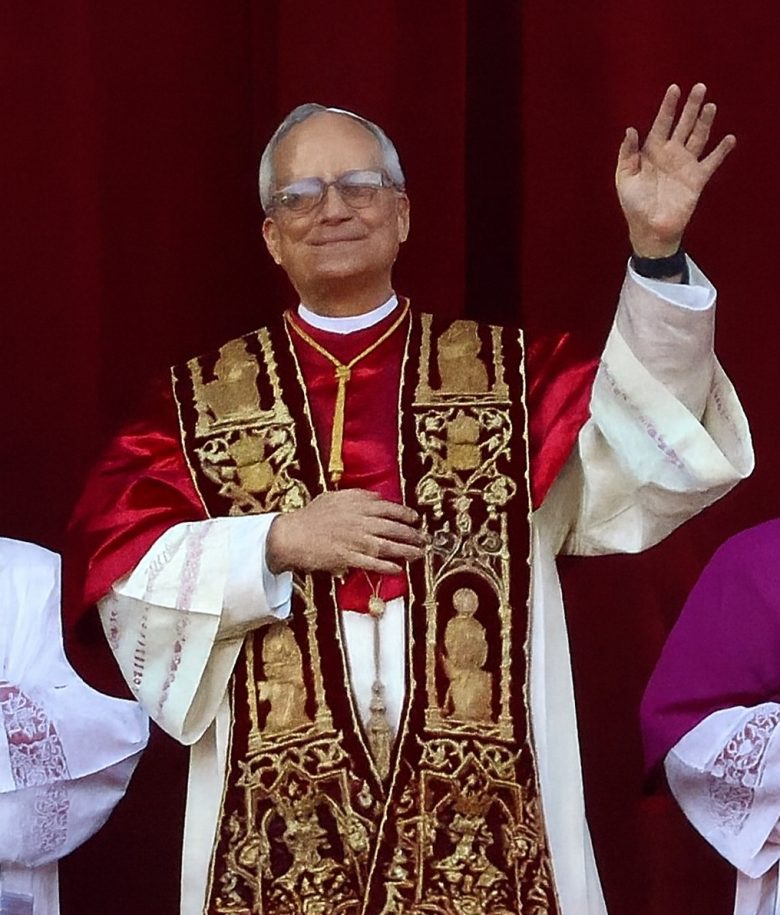
- Lead. Pope Leo XIV warned at Europe’s largest university that AI-directed warfare is driving a “spiral of annihilation,” and that governments are accelerating the trend rather than halting it.
- Fact. Military spending — particularly in Europe — surged in 2026 while education and health budgets shrank, the pontiff said at Rome’s La Sapienza, which has not hosted a pope since 2008.
- Stake. The speech previews Leo’s first papal encyclical, expected in the coming weeks, marking the clearest indication yet of the emerging doctrine he intends to define his papacy around.
Pope Leo XIV chose La Sapienza University — the largest in Europe and one of the oldest in the world — on May 14 for his most explicit critique yet of how artificial intelligence is reshaping armed conflict. Speaking to thousands of students and faculty in Rome, the American-born pontiff said that what is unfolding in Ukraine, Gaza, Lebanon, and Iran “illustrates the inhuman evolution of the relationship between war and new technologies in a spiral of annihilation.”
Public money, private gain
Leo focused particular criticism on the direction of public resources. Defense budgets have risen sharply across Europe in 2026 — driven by the Ukraine war and the Iran conflict’s pressure on energy costs and security planning — while spending on education and healthcare has contracted. The pope argued this shift is enriching “elites who care nothing for the common good” while ordinary citizens absorb the costs. He called it a concert of destruction fueled by misaligned financial incentives rather than genuine security logic.
His critique was targeted, not sweeping. Leo called specifically for stronger oversight of how AI is developed and used in military and civilian contexts, “so that it does not absolve humans of responsibility for their choices and does not exacerbate the tragedy of conflicts.” The concern is structural: automated systems diffuse moral accountability for lethal decisions, and no international governance architecture currently prevents it.
A Palestinian student in the audience
The setting added personal weight to the address. Among those present was Nada Rahim Jouda, 19, a Palestinian student studying business science who arrived at La Sapienza through a humanitarian corridor — part of a group of young Gazans brought to Italy to continue their education during the conflict. Leo met with her directly during the visit, grounding his argument in a specific face rather than abstraction alone.
La Sapienza had not hosted a pope since 2008, when Benedict XVI withdrew from a planned address after faculty protests over his views on science. Leo’s reception was categorically different. The visit was framed as a dialogue, not a lecture.
The encyclical question
Vatican observers are watching the Sapienza address as a preview of Leo’s first encyclical, expected within weeks. An encyclical is the highest-level teaching document a pope issues and carries formal doctrinal weight across the 1.4-billion-member Catholic Church. If AI and warfare are its organizing themes, it would position the Church in direct tension with the defense procurement choices of many Catholic-majority states — including Italy, Poland, and Brazil — that have expanded military budgets in 2026. Leo has consistently identified AI as among the most consequential challenges facing humanity. His Sapienza address signaled that his papacy intends to make it a defining moral confrontation.