
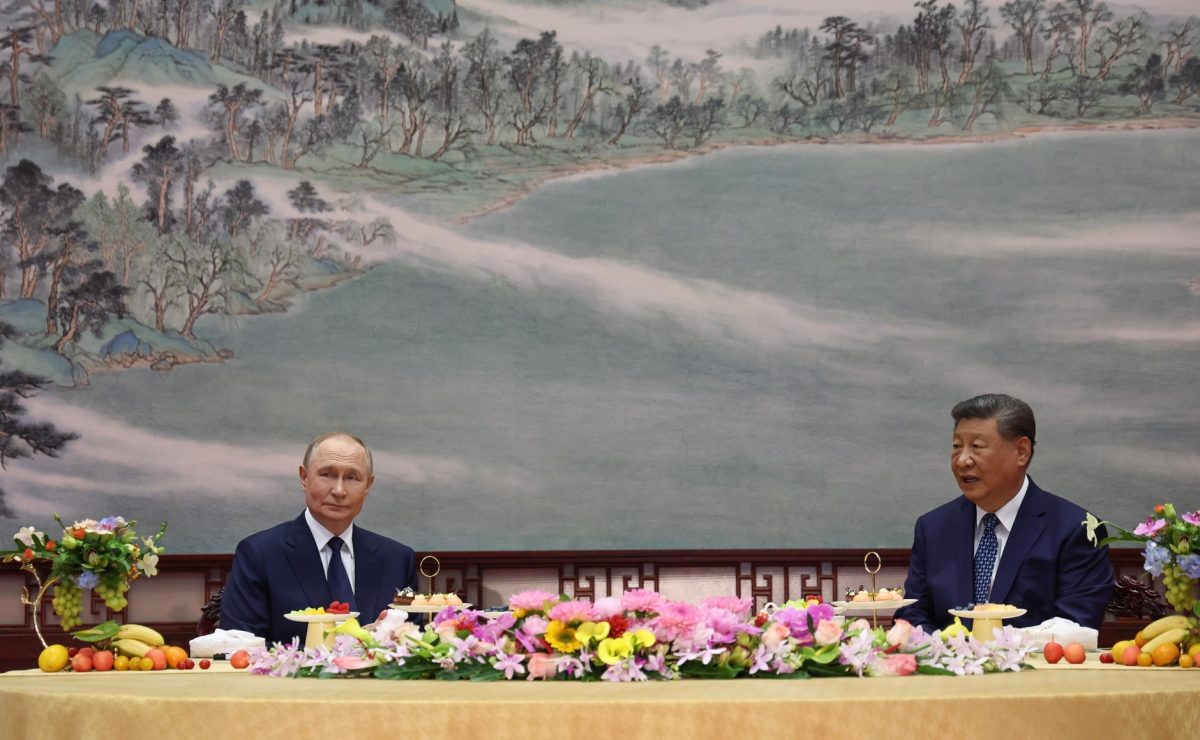
- Lead. Vladimir Putin arrived in Beijing on May 19 for a two-day state visit — his 25th trip to China — receiving Xi Jinping at the Great Hall of the People just five days after Donald Trump’s own summit in the Chinese capital.
- Fact. Two-way Russia-China trade reached $245 billion in 2024, more than doubling from 2020, with Russian oil exports to China rising 35% in Q1 2026 alone.
- Stake. The back-to-back summits force Beijing to demonstrate, in the same week, that it can manage both Washington and Moscow — a test of Xi’s claim that China remains a neutral actor capable of mediating the world’s sharpest rivalries.
Vladimir Putin touched down at Beijing Capital International Airport on the morning of May 19, greeted with a state-level reception before proceeding to meetings at the Great Hall of the People. The visit marks the 25th anniversary of the 2001 Treaty of Good-Neighbourliness and Friendly Cooperation — and, in practice, the 25th time Putin has visited China since first taking power. That the summit falls within a week of Donald Trump’s May 14–15 visit to Beijing was not incidental to either side’s diplomatic calendar.
Before talks began, Putin told reporters that Russia and China represent a “stabilising” force on the world stage and that Moscow and Beijing “do not wish to align against any other country but work together for peace and universal prosperity.” The framing is one Beijing has echoed: neither capital wants the Russia-China relationship formally characterized as an anti-American alliance, even as the practical content of that relationship moves steadily in that direction.
What the trade numbers reveal
Russia-China bilateral trade more than doubled between 2020 and 2024, reaching $245 billion — a figure that would have seemed implausible before the 2022 Ukraine invasion. The composition has also shifted. China now exports machinery, vehicles, electrical equipment, and textiles to Russia at scale, substituting for Western goods cut off by sanctions. Russia exports energy: oil, gas, and coal flow east in quantities that have grown each quarter since the war began.
Russia’s oil exports to China grew 35% in the first quarter of 2026 alone, a period when Iranian conflict disruptions simultaneously tightened global supply and raised prices. Putin indicated ahead of the summit that “practically all the key issues have been agreed upon” in the oil and gas sector, and that the visit would formalize those arrangements. The specific pipeline and pricing terms were not disclosed; energy deals of this scale are typically announced with the minimum of public detail.
Xi’s navigation after Trump
The timing is not merely symbolic. Trump’s Beijing summit produced limited concrete outcomes — a Boeing deal and vague language on Iran — but it signalled Washington’s appetite to re-engage China bilaterally, at least on selective terms. Xi’s decision to receive Putin with full ceremonial honours five days later is a message about the limits of that re-engagement: Beijing will not allow any improvement in US-China relations to come at the cost of its partnership with Moscow.
Russia, for its part, needs the relationship to be more than symbolic. International isolation since 2022 has made China not just Russia’s top trading partner but its primary conduit for technology, components, and financial flows that Western sanctions have tried to sever. Putin’s 25th visit carries the accumulated weight of that dependency — and underscores how thoroughly the war in Ukraine has reorganized Russian foreign policy around a single bilateral anchor.
Whether Xi can sustain the posture of equidistance — managing Trump’s overtures while deepening ties with Moscow — without triggering secondary sanctions from Washington remains the central structural question for the relationship. The answer will not be found in any one summit communiqué.