
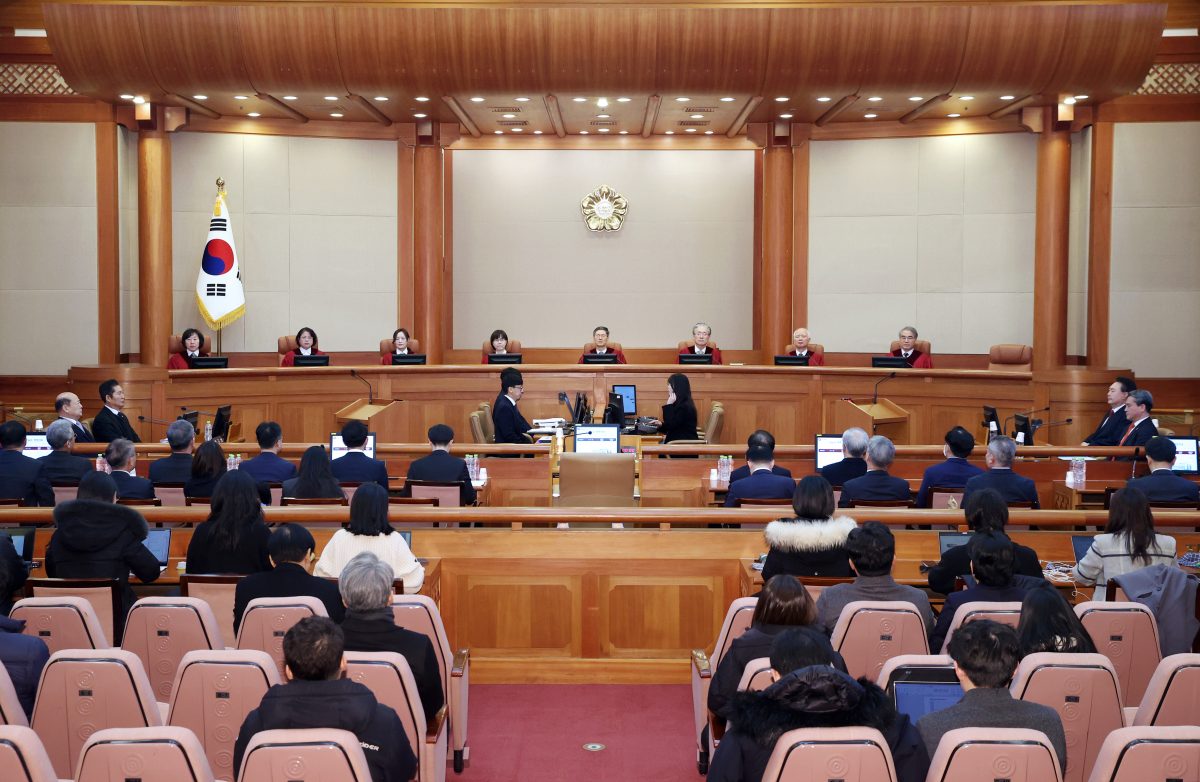
- Lead. A Seoul court sentenced former South Korean President Yoon Suk Yeol to 30 more years in prison on June 12, finding him guilty of ordering military drones into North Korean airspace in October 2024 to manufacture a pretext for his martial law declaration.
- Fact. Former Defence Minister Kim Yong-hyun received an equal 30-year term; Yeo In-hyung, former head of the Defence Counterintelligence Command, was sentenced to 15 years for his role in coordinating the operation.
- Stake. The ruling lands on top of a life sentence Yoon received in February for leading an insurrection, deepening a legal reckoning that has already reshaped South Korean politics and strained the security environment on the peninsula.
What the court found
The Seoul Central District Court found Yoon guilty of abuse of power and aiding the enemy, concluding that he approved a covert drone operation over Pyongyang with the express purpose of provoking North Korea into a hostile response. According to the court’s ruling, Yoon calculated that a North Korean provocation would justify declaring emergency martial law under his own authority. “Defendant Yoon Suk Yeol approved the operation in this case to create conditions that would justify declaring emergency martial law, believing that he could use such authority at will for his own political interests,” the court stated.
The drones flew over Pyongyang on at least three occasions in October 2024, carrying propaganda leaflets. North Korea publicly accused Seoul of the incursions at the time. The court found that beyond the political motivation, the operation harmed South Korea’s military interests by exposing the country’s drone capabilities to the North and using public defence resources for private political purposes.
Two convictions, compounding sentences
Friday’s 30-year sentence is additive. In February 2026, a separate court convicted Yoon of leading the insurrection tied to his December 2024 martial law declaration and sentenced him to life. He is now serving a life term with an additional 30 years appended — an outcome without modern precedent in South Korean judicial history.
Kim Yong-hyun, identified by prosecutors as the principal organiser of the drone operation, also received 30 years. Yeo In-hyung, who headed the Defence Counterintelligence Command and is alleged to have coordinated the logistics of the overflights, was sentenced to 15 years. Yoon’s legal team filed an appeal later on Friday, arguing that the drone flights were a legitimate response to North Korean provocations rather than a fabricated crisis.
Consequences for the peninsula
The convictions carry implications beyond Yoon’s personal fate. North Korea’s public accusation in October 2024 that Seoul had sent drones over Pyongyang elevated rhetoric on the peninsula at a moment when Kim Jong-un was accelerating missile tests and uranium enrichment activity. Seoul’s implicit acknowledgement — through the guilty verdict — that military assets were deployed for domestic political purposes provides Pyongyang a durable propaganda point.
South Korea’s ruling Democratic Party welcomed the verdict as confirmation that the drone operation was an abuse of state power. Yoon’s allies, who maintained that the martial law declaration was a constitutionally legitimate response to security threats, condemned the ruling as politically motivated.
Both the insurrection conviction and Friday’s drone ruling are subject to appeal, meaning Yoon may contest each sentence through the appellate courts and potentially the Supreme Court — a process likely to extend over several years.