
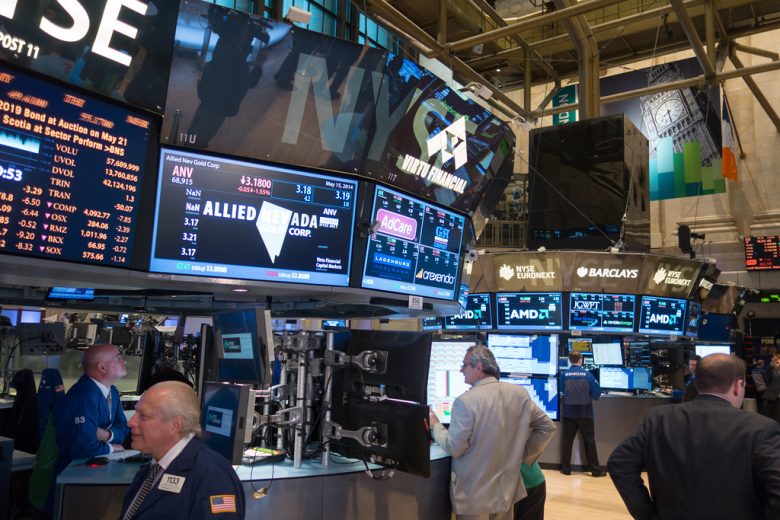
- Lead. US equity markets retreated on September 5 after August’s non-farm payrolls report showed 162,000 jobs added — nearly three times the consensus estimate of 55,000 — rekindling expectations that the Federal Reserve will raise interest rates at its September policy meeting.
- Fact. The Dow Jones Industrial Average fell 271 points, or 0.51 percent, closing at 53,414; the S&P 500 dropped 0.38 percent to 7,718; the Nasdaq Composite declined 0.29 percent to 26,507. The two-year Treasury yield rose to its highest level since January 2025, according to reporting by Yahoo Finance.
- Stake. CME Group’s FedWatch tool showed the probability of a rate hike at the September FOMC meeting jumping to roughly 58 percent — a significant reversal from earlier in the week, when markets had priced a hold as the base case after Fed Governor Christopher Waller signalled he would be “inclined to support” steady rates.
The payrolls report, released Friday morning, demolished the narrative that the US labour market was softening enough to give the Fed cover to leave rates unchanged. The unemployment rate held at 4.1 percent, and the gain in non-farm payrolls was the largest since early in the year. As Wall Street had rallied sharply earlier in the week on Waller’s dovish tone, Friday’s reversal effectively unwound much of that advance in a single session.
Treasuries Bear the Brunt
The bond market reaction was sharper than the equity selloff. The two-year Treasury yield — the maturity most sensitive to near-term Federal Reserve policy expectations — rose significantly after the print, reaching levels not seen since January 2025 when the Fed was still in the midst of its earlier tightening cycle. The benchmark 10-year yield also climbed, though it remained below the 5 percent level that market participants treat as psychologically significant.
The move in yields reflects a straightforward repricing: if the Fed is more likely to hike in September, risk-free bonds at current yields become less attractive relative to the prospect of higher future yields, pushing existing bond prices lower and yields higher. Investors who had positioned for a prolonged hold faced mark-to-market losses across fixed income portfolios.
The Rate-Hike Arithmetic
The September Federal Open Market Committee meeting is scheduled for mid-month. Before the payrolls release, market consensus had been roughly split between hold and hike, with Waller’s comments earlier in the week nudging the probability toward hold. That consensus has now shifted. At 58 percent, a hike is the more likely outcome in market pricing — though not a certainty, and a softer-than-expected CPI print later this month could still shift the calculus back toward hold.
The FOMC’s June minutes showed committee members had removed rate-cut language from their guidance and flagged that core PCE inflation, running at 3.3 percent in April, remained “well above” the 2 percent target. The August labour market data suggests there is no immediate economic case for easing — and potentially a case for tightening.
Sector Rotation
Within the equity market, the selloff was not uniform. Interest-rate sensitive sectors — real estate investment trusts, utilities and long-duration technology stocks — underperformed, while financials and energy held up somewhat better. Tesla advanced more than 7 percent in earlier trading in anticipation of its Cybercab product event, providing a partial offset to broader market weakness, though the overall tape closed lower. Crypto-linked equities declined alongside Bitcoin, which pulled back from earlier highs.