
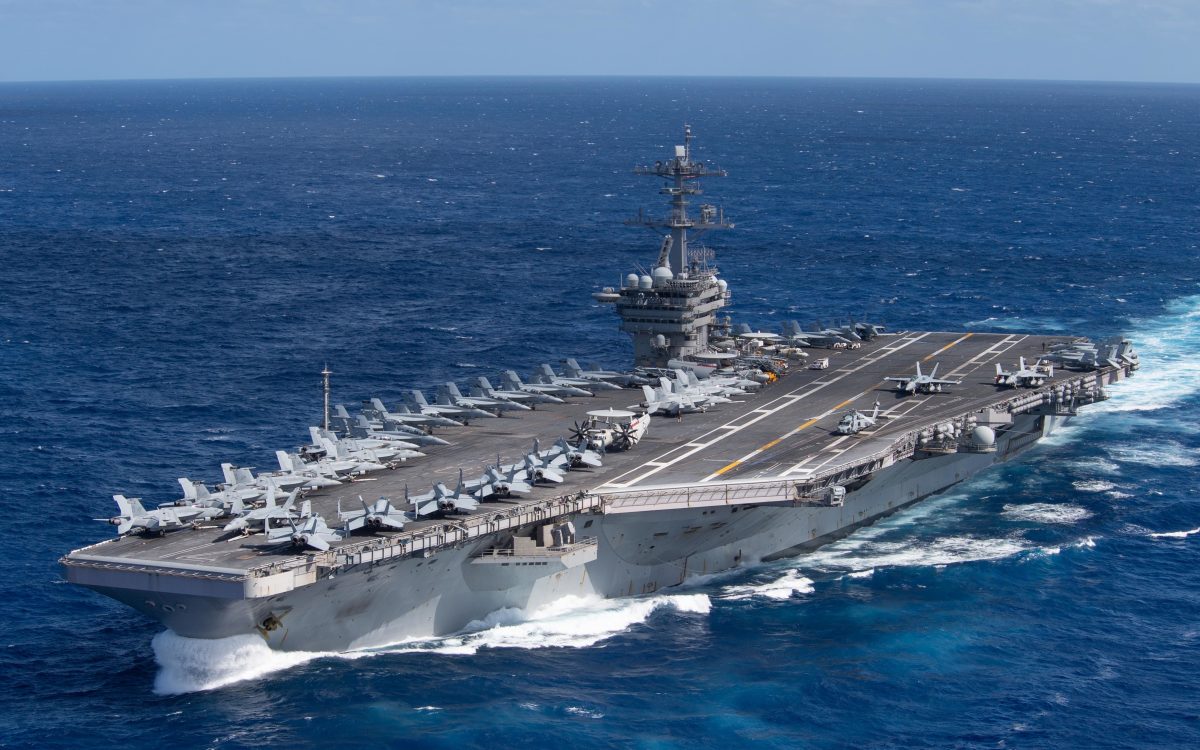
- Lead. The USS Theodore Roosevelt carrier strike group left San Diego on October 2, 2026, adding approximately 9,000 to 10,000 sailors and Marines to a US military presence in the Middle East that already stood at around 50,000 personnel.
- Fact. The Roosevelt’s arrival — expected by late October — would give the United States three aircraft carriers operating simultaneously near Iran for the first time since the conflict began in February, alongside two amphibious landing groups.
- Stake. Washington’s stated aim is to maintain military options as indirect diplomacy with Tehran remains deadlocked, while the buildup lands during a politically sensitive window roughly one month before US midterm elections.
The USS George HW Bush and USS George Washington are already operating in the region. According to officials cited by The National News, the Roosevelt’s deployment gives President Trump “a wider menu of options if he decides to act,” language that leaves open whether the buildup is primarily a deterrent or a preparatory posture for escalation. The USS Makin Island amphibious readiness group — carrying more than 2,000 Marines and F-35B aircraft — departed a day after the Roosevelt, compounding the force projection.
The state of the war and the diplomacy
The conflict began in late February when Iranian-linked forces struck a US facility in Jordan, triggering a US counterattack that has since expanded into a sustained air and naval campaign against Iranian military infrastructure. Eight months in, active fighting has slowed, but neither side has found terms for a ceasefire it is willing to accept. Iran’s most recent public offer — reopening the Strait of Hormuz in exchange for sanctions relief, resumed nuclear talks, and a regional ceasefire covering Lebanon and Yemen — was rejected by Trump, who told the UN General Assembly in late September that Iran must “decide to sign a very fair deal, or they won’t exist any longer.”
Indirect talks, facilitated through Oman and European intermediaries, have continued at a low level. Iranian President Pezeshkian stated at the margins of the UN General Assembly that Tehran has “never shied away from talks.” But the two sides remain far apart on verification arrangements and the scope of any sanctions relief, and there is no date set for a new round of substantive negotiations.
Why three carriers, why now
Carrier rotations in a protracted conflict are partly logistical: the USS George Washington has been deployed since August and requires eventual relief, a role the Roosevelt is formally designated to fulfill. But the deliberate overlap window — when all three carriers will be within reach of Iranian territory simultaneously — creates a concentration of force that officials acknowledge has not been seen in the Gulf in modern times.
The domestic timing adds a layer of complexity. Midterm elections are approximately five weeks away, and the war remains unpopular in polling. The administration has framed the deployment as a defensive precaution against Iranian escalation rather than preparation for offensive action, but the distinction is difficult to sustain politically as the footprint grows.
Regional and market effects
Brent crude, which had retreated toward $100 per barrel as some Middle East export routes stabilised, reacted modestly to the deployment announcement, with traders weighing the escalation signal against the absence of any immediate kinetic trigger. The Strait of Hormuz carries roughly 20% of global oil trade. Any disruption to transit — whether from Iranian action or a miscalculation — would have immediate consequences for energy prices in markets already strained by nine months of conflict-driven disruption.