
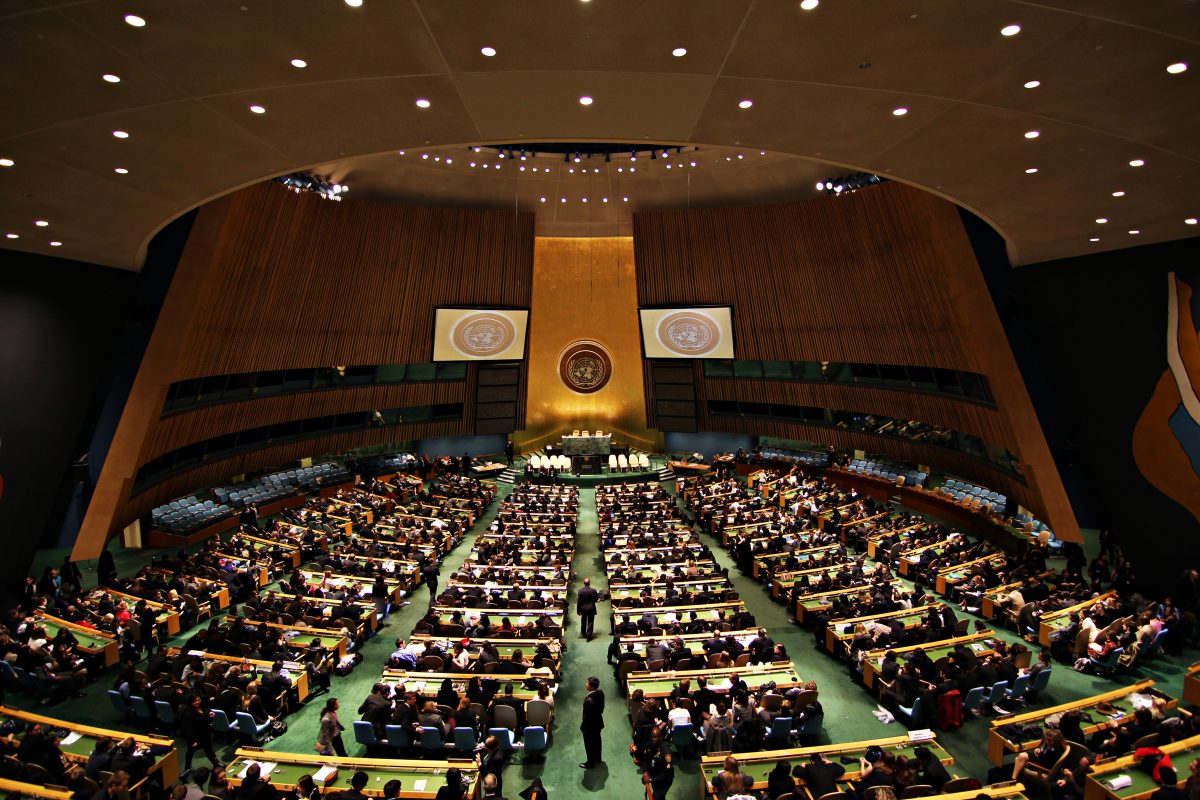
- Lead. President Trump told the UN General Assembly on September 22 that he faces a binary choice on Iran: strike a deal or “annihilate the Islamic Republic” — his most explicit public framing yet of how the seven-month war ends.
- Fact. Trump set one non-negotiable condition — “Iran will never have a nuclear weapon” — and signalled that formal negotiations will not begin until after November’s midterm elections, because Tehran is “waiting to see how I do.”
- Stake. The midterm timeline turns Iran into an election variable, reducing pressure on both sides to act quickly while sharpening Trump’s domestic political incentive to resolve the conflict on visible terms before 2027.
Speaking from the General Assembly podium in New York, Trump presented a starkly binary ultimatum: “Will a deal be made with Iran that lets them rebuild and create a far greater country than it ever was before … or do I annihilate the Islamic Republic, and do it quickly?” He added a second formulation — “Do I drive them into hell with no chance of survival” — leaving no ambiguity about the military option’s scope. The remarks came on the first day of the 81st UNGA’s high-level debate, with Brazilian President Luiz Inácio Lula da Silva speaking first and Turkish President Recep Tayyip Erdoğan scheduled to follow.
The Nuclear Line and the Election Clock
Trump’s core demand is unchanged from the beginning of the conflict: Iran must permanently forgo nuclear weapons capability. But his framing of the timeline was notable. He said he expects a deal to happen “right after the election because it doesn’t make sense for them not to,” describing Iranian leadership as calculating his domestic political standing before committing to talks. That framing puts the earliest plausible opening for formal negotiations at late November 2026 — after US midterms on November 3.
Iranian President Masoud Pezeshkian is also in New York this week, addressing the assembly Wednesday. His delegation arrived with a seven-point framework of its own, including a demand to lift the naval blockade and release frozen assets. The two leaders will not meet. Tehran’s conditions and Washington’s preconditions remain far enough apart that Oman-mediated backchannel talks remain the most active diplomatic track.
Other Announcements at the UN
Trump used the speech to announce a Greenland security deal to be signed Tuesday, giving the United States “permanent control over security” in the autonomous territory. He described a US-Venezuela oil agreement — 100-year development rights over 17 fields holding 65 billion barrels of proven reserves — as “perhaps the biggest deal ever made,” a characterisation Venezuela’s acting president Delcy Rodríguez would likely dispute. On Ukraine, Trump repeated his claim that the war will end “more quickly than people understand.”
Trump also confirmed that a meeting with Chinese President Xi Jinping is planned for later this week in Washington — a summit that will carry its own Iran dimension, as Beijing has been supplying dual-use technology to Tehran throughout the conflict. Whether the UNGA speech’s maximalist language on Iran constrains or expands Trump’s room to offer Xi a partial trade-for-restraint deal is the central question of the summit week.