
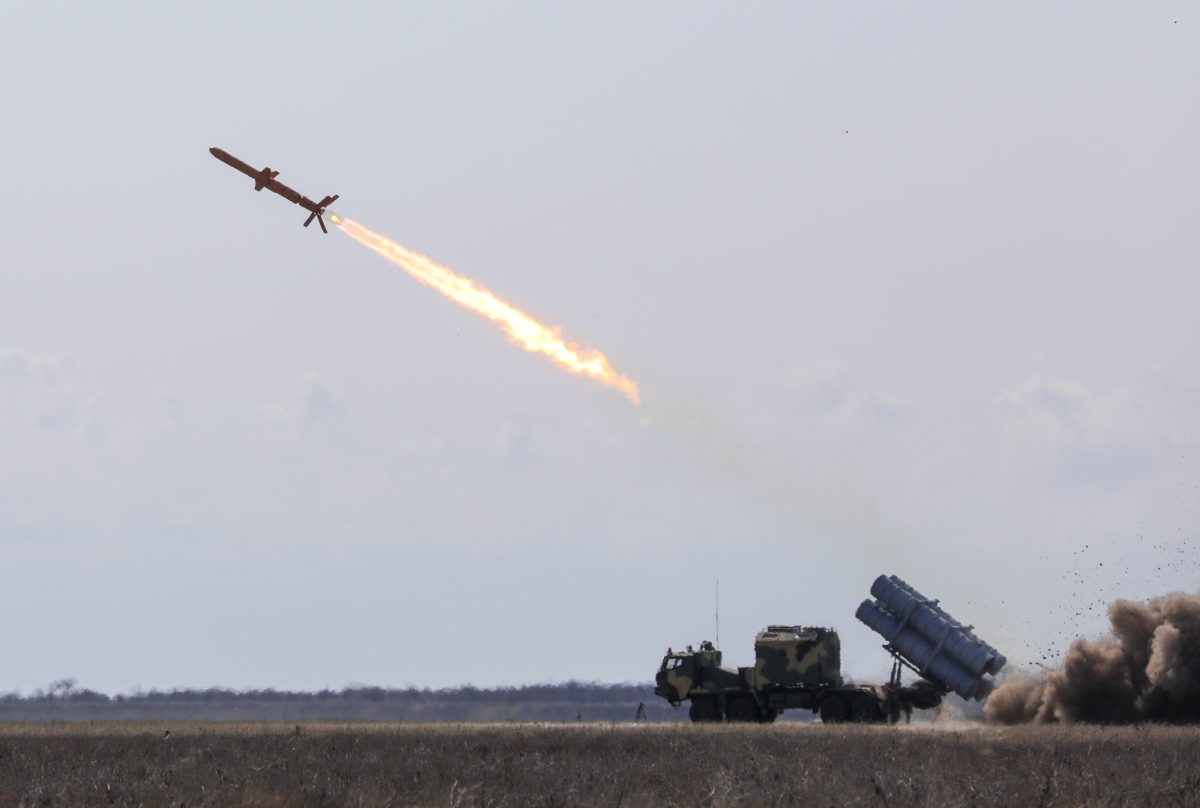
- Lead. Ukraine’s domestically built FP-5 Flamingo cruise missiles struck the Federal Research and Production Center Titan-Barrikady in Volgograd overnight on June 26–27, setting fires at one of Russia’s most sensitive military manufacturing sites.
- Fact. Titan-Barrikady produces the self-propelled launchers for Russia’s Iskander-M ballistic missiles, its Yars and Topol-M intercontinental missiles, and—according to Ukrainian and open-source reporting—components linked to the Oreshnik hypersonic system. Ten people were injured; no residential damage was reported.
- Stake. The Flamingo is a Ukrainian-designed and Ukrainian-built weapon, not a Western-supplied system. Its use sidesteps the political restrictions on Western arms striking Russian soil—and signals a deepening indigenous deep-strike capability that Moscow cannot pressure Western capitals to constrain.
The target and what it builds
Titan-Barrikady is not a generic factory. Located in Volgograd’s Krasnooktyabrsky District, roughly 400 kilometres from Ukraine’s eastern front, the facility manufactures the transporter-erector-launcher vehicles that make Russia’s most consequential missile systems mobile and survivable. The Iskander-M, which Russia fires daily into Ukrainian cities and infrastructure, leaves this facility on a launcher built here. So do the Yars and Topol-M intercontinental ballistic missiles—the delivery systems at the heart of Russia’s strategic nuclear deterrent.
According to Militarnyi and Defence Express analysis of the strike, the plant is also linked to Oreshnik launcher components. Putin has deployed the Oreshnik as a near-nuclear escalatory signal in the war, making Titan-Barrikady one of the more significant targets Ukraine has ever attempted to reach.
Zelensky confirms; Moscow stays silent
President Zelensky confirmed the strike publicly, describing the target as “a major industrial complex where Russia produces artillery systems and specialised military equipment, including components for missile launch systems used in attacks against our people.” Open-source analysts assessed at least three missiles as hitting targets across two workshops and a production building.
Volgograd Governor Andrey Bocharov acknowledged that Ukrainian “high-speed aerial targets” had struck production facilities in the Krasnooktyabrsky District; ten people were injured and received medical treatment. Russia’s Defence Ministry, which claimed overnight to have shot down 175 Ukrainian drones, made no mention of the Flamingo strike on Titan-Barrikady—a silence that has become a standard feature of Russian official communications when attacks on sensitive military infrastructure are involved.
A weapon that bypasses Western restrictions
The FP-5 Flamingo is central to the story within the story. Unlike the Storm Shadow cruise missiles or ATACMS ballistic rockets whose use on Russian territory has required explicit authorisation from Washington and London, the Flamingo is a domestically designed Ukrainian system. Its deployment removes the political chokepoint that has repeatedly slowed Ukraine’s campaign inside Russia’s borders.
The Volgograd strike was part of a larger overnight operation. Ukraine also struck a Pantsir-S1 air defence system in Feodosia, Crimea, and hit the Petropavlovsk cargo ferry near the Kerch Strait. The Kyiv Independent, which first reported the Titan-Barrikady strike, described it as part of a 40-day strategic pressure campaign authorised by Zelensky aimed at forcing Russia toward negotiations—a campaign that is now demonstrably reaching targets, and weapons systems, that earlier phases of the war could not touch.