
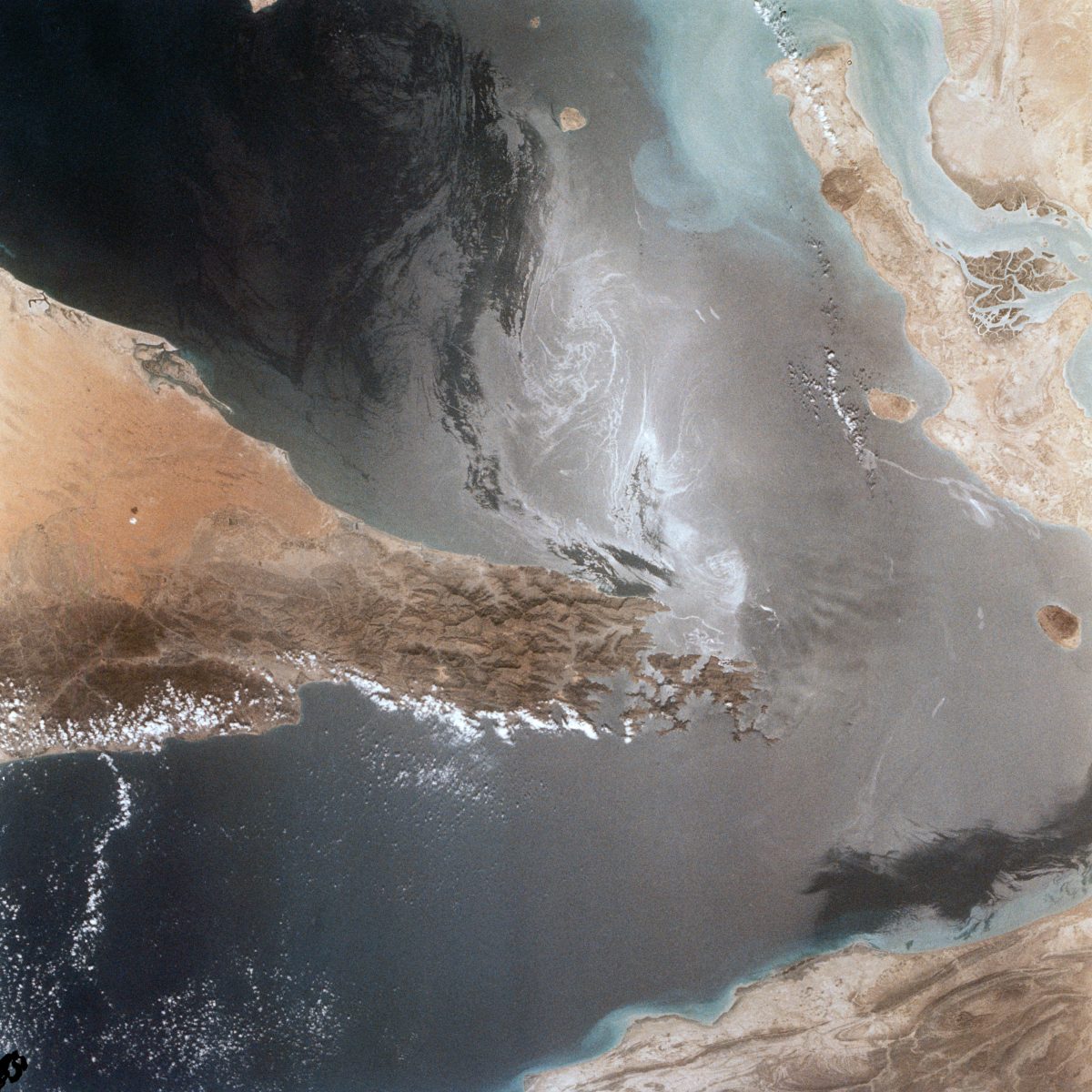
- First strike in a month. US forces hit two Iranian rocket launchers on Larak Island on August 31, targeting equipment reportedly being used to disperse sea mines in the Strait of Hormuz.
- Escalation loop. The IRGC responded by firing at air bases in Jordan and the UAE; Jordan’s armed forces said they intercepted and destroyed eight missiles, and the UAE confirmed intercepting one Iranian drone.
- Price signal. Brent crude climbed above $90 per barrel in response — up roughly 25 percent from the start of the conflict — as shipping companies and energy traders repriced Hormuz risk.
The strikes on Larak Island
On August 31, US military forces struck two Iranian rocket launchers positioned on Larak Island in the Strait of Hormuz, according to Just Security. The launchers were reportedly being used to disperse naval mines in the strait — the world’s most critical oil chokepoint, through which roughly 20 percent of global crude passes — in what American officials described as a direct threat to freedom of navigation.
The action marked the first known US strike in the strait since late July. In recent weeks, IRGC naval forces and a US-led blockade had maintained an uneasy stalemate over passage rights, with neither side willing to trigger a full escalation. That equilibrium broke on August 31.
Iran’s counterstrike and regional spillover
The Islamic Revolutionary Guards Corps (IRGC) responded within hours, firing missiles at air bases in Jordan and the United Arab Emirates. Jordan’s armed forces announced they had “intercepted and destroyed eight missiles.” The UAE’s Defense Ministry confirmed intercepting one Iranian drone but denied Iranian reports that Al Minhad Air Base had been struck by missiles.
The exchange represents one of the sharpest escalation cycles since February, when a joint US-Israel operation struck Iranian military and nuclear sites. More recently, diplomacy through Oman had attempted to set navigational parameters for the strait, but Washington and Tehran failed to close on their core demands. The August 31 exchange suggests that diplomatic channel has not held.
Markets and parallel diplomacy
Brent crude rose above $90 per barrel on August 31, roughly 25 percent above prices at the conflict’s outset earlier in 2026. The Dow Jones Industrial Average fell more than 370 points in Monday’s session, with the S&P 500 and Nasdaq also declining. US national average gasoline prices reached $4.07 per gallon.
On a separate track, CIA Director John Ratcliffe was reported to have proposed a trilateral meeting between President Trump, Vladimir Putin and Volodymyr Zelenskyy during talks with Russian officials. Zelenskyy acknowledged receiving US briefings and thanked Washington for “the necessary tone of the conversation with Russia” — a signal that American engagement with both Moscow and Tehran is running on parallel, if uncoordinated, tracks.