
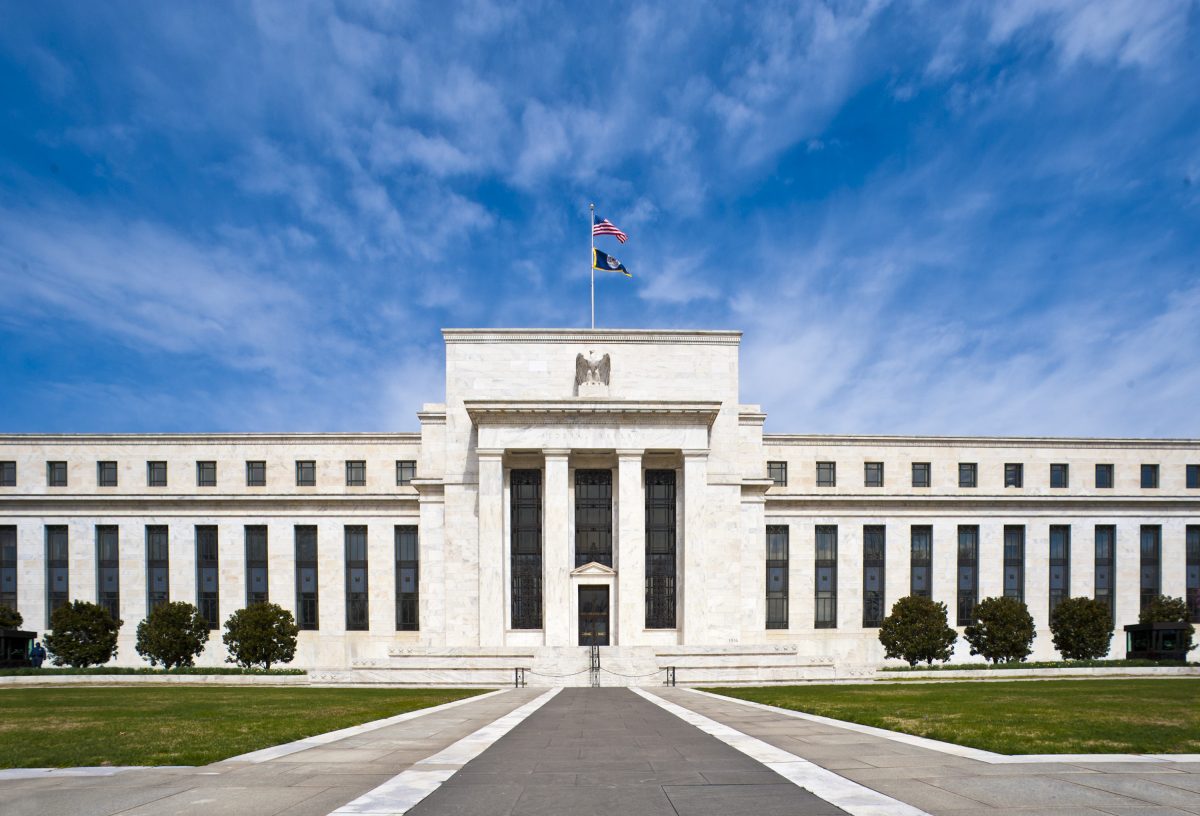
- Pivot. If the Federal Reserve raises rates on Wednesday, it will be the first increase since 2023 — a reversal of the easing cycle that markets had expected only a year ago, driven by inflation proving stickier than forecast.
- Odds. Futures markets priced an 83% probability of a 25-basis-point hike to 3.75%–4.00% heading into the two-day meeting, with Goldman Sachs and J.P. Morgan both projecting a move.
- Tension. Chair Kevin Warsh is navigating the decision under overt political pressure from President Trump, who has repeatedly called for rate cuts — a dynamic that amplifies the stakes of whatever the committee chooses.
The Federal Open Market Committee convened Monday for its September meeting, with the committee’s rate decision scheduled for Wednesday at 2 p.m. Eastern time. Financial markets are pricing an 83% probability that the Fed raises its benchmark federal funds rate by 25 basis points — a move that would push the target range from 3.50%–3.75% to 3.75%–4.00% and mark the first tightening since 2023, according to FedRateCalc.
What Has Shifted the Calculus
When the FOMC last voted — a 9–3 hold in July — the inflation picture was already elevated, but energy prices were somewhat lower. Since then, August consumer prices came in at 3.4% year-on-year, with gasoline and diesel costs linked to supply disruptions from the ongoing Iran conflict keeping the headline figure well above the Fed’s 2% target. The August CPI reading pushed market-implied hike odds sharply higher after its September 11 release.
Separately, nonfarm payrolls for August came in well above estimates, erasing some of the softness seen in private-sector hiring data from earlier in the month and leaving the unemployment rate near 4.2%. A resilient labour market has removed one of the principal arguments for holding rates steady: that a slowing economy would eventually bring inflation back to target without further tightening.
Warsh, the Dot Plot, and Political Noise
Chair Kevin Warsh’s debut at the Jackson Hole symposium in late August set a hawkish tone, signalling that inflation was “still too high” and that the committee retained the option to act. September is one of the four meetings per year that includes the Summary of Economic Projections and the “dot plot” of individual rate forecasts, making Wednesday’s decision more revealing than an interim hold would be. Any upward shift in the median dot for 2026 would indicate the committee expects to tighten further before year-end.
Warsh is making the call under conditions no recent Fed chair has faced: President Trump has publicly and repeatedly called for lower borrowing costs, most recently framing high energy prices as a consequence of the Iran conflict rather than of Fed policy. The Fed’s legal independence shields Warsh from direct presidential instruction, but economists note that political pressure can affect the perceived credibility of any decision. Consumer sentiment has fallen to its second-lowest level on record ahead of the meeting, complicating the messaging challenge for any outcome.
What a Hike Would Signal
A 25-basis-point increase would take the Fed’s target range to its highest level since 2001. It would also represent a clear break from the trajectory that prevailed in late 2024 and early 2025, when the committee was cutting rates in response to cooling inflation. The reversal reflects the extent to which the Iran-linked energy shock has disrupted the disinflation path, and it could signal that borrowing costs remain elevated well into 2027 if energy prices stay high. A hold, by contrast, would likely read as a conditional pause — leaving the door open for action in November — rather than a signal that the tightening cycle is over.