
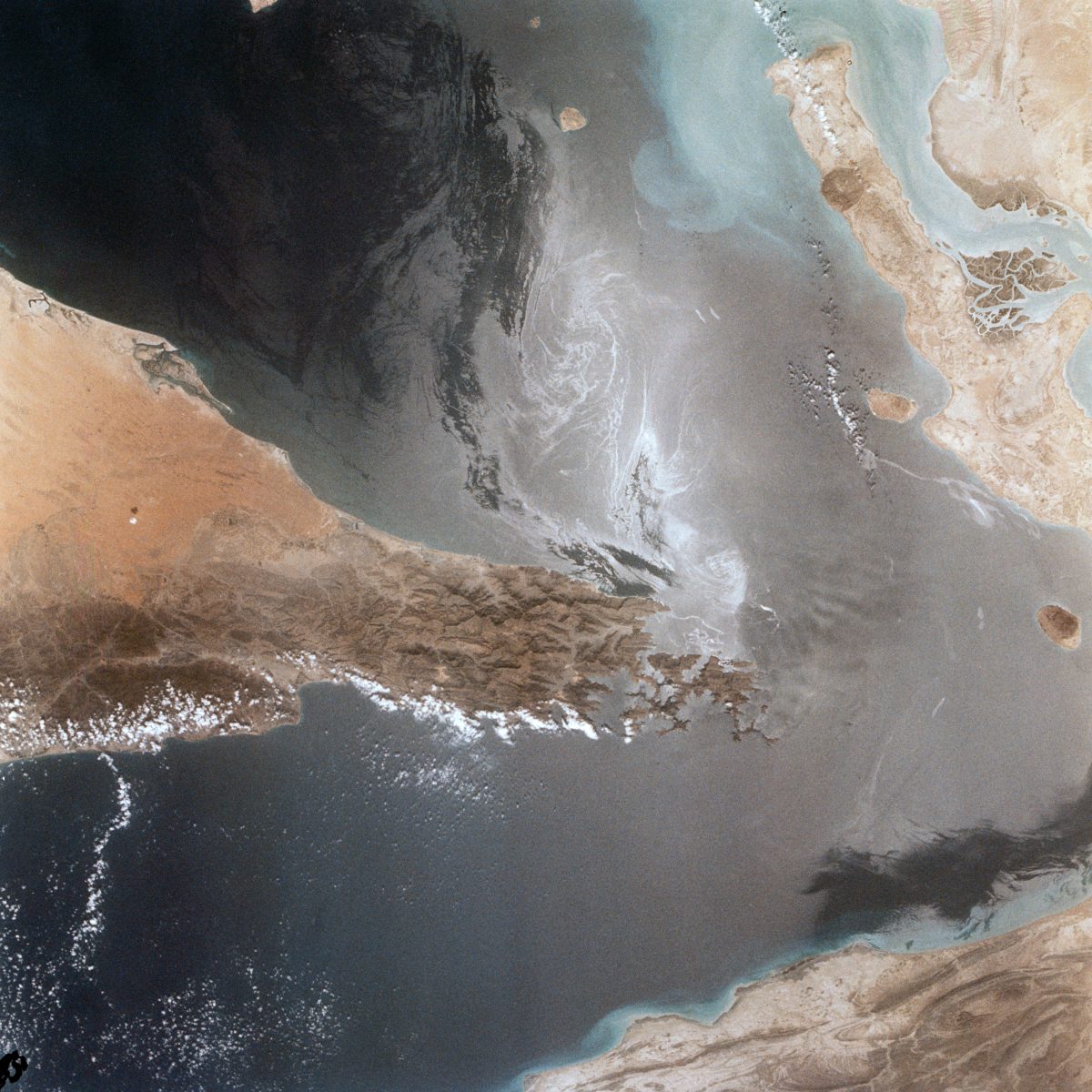
- Lead. Iran’s Islamic Revolutionary Guard Corps launched ballistic missiles and drones at US military installations in Kuwait and Bahrain on Sunday, after US forces struck ten Iranian targets along the Strait of Hormuz the previous day.
- Fact. The exchange follows the June 17 ceasefire memorandum, which gave both sides 60 days to reach a negotiated settlement — it has now been violated within 11 days of signing.
- Stake. The Strait of Hormuz carries roughly 20 percent of the world’s oil supply; a full breakdown of the accord risks renewed closure of one of the most critical maritime chokepoints on earth.
The weekend’s military exchange
The cycle began on Thursday, June 26, when a container ship, the Singapore-flagged Ever Lovely, was struck by a drone 7.5 nautical miles off the Omani coast while transiting a UN-backed evacuation corridor. The British military confirmed bridge damage to the vessel but reported no casualties. Two US officials told Reuters that Iran had fired on the ship; Tehran’s newly established Persian Gulf Strait Authority warned that vessels travelling outside routes it had designated “will not be guaranteed safe passage.”
The United States responded with airstrikes targeting Iranian missile and drone storage locations and coastal radar sites near Sirik and Bandar-e Lengeh on Friday. Saturday brought a second US strike package, hitting ten targets including positions on Qeshm Island. Iran’s IRGC then launched its own counterstrike on Sunday, firing ballistic missiles and drones at the US Ali Al Salem airbase in Kuwait and at the US Fifth Fleet’s home port at Salman in Bahrain, claiming to have destroyed eight US military facilities. No American casualties were reported in those attacks, though one Qatari citizen died from shrapnel wounds during the weekend’s broader regional operations.
A ceasefire text already under dispute
The June 17 memorandum of understanding that ended weeks of direct US-Israeli strikes on Iran contained an Article 5 whose language both sides now read in opposite ways. According to Al Jazeera, Article 5 requires Iran to use “best efforts” for the safe passage of commercial vessels for 60 days, with removal of technical and military obstacles within 30 days. Iran’s Foreign Minister Abbas Araghchi maintains that the strait remains under Tehran’s “total oversight and management” and that any unilateral routing outside Iranian-approved channels “will increase tensions.” Washington and its allies back freedom of navigation along Oman- and IMO-coordinated routes.
The International Maritime Organization suspended its operation to evacuate vessels and seafarers stranded inside the Middle East Gulf after the Ever Lovely attack, pausing “in order to reconfirm that the necessary safety guarantees continue to be in place.” Commercial transit through the strait fell from roughly 70 ships on Wednesday to 40 by Saturday.
Gulf states condemn, talks remain formally alive
Bahrain condemned the Iranian missile and drone strikes as a violation of its sovereignty and a threat to “opportunities for de-escalation.” Kuwait called Tehran’s actions a “flagrant violation” of its territory. Qatar, the UAE, Jordan, and Oman all issued statements condemning the escalation. Despite the attacks, a US official told CBS News that negotiations between Washington and Tehran would continue, with both sides having stood down by Sunday afternoon and vessels permitted free movement through the strait once more.
President Trump posted on Sunday that US forces had struck Iranian targets “for violating the Cease Fire Agreement, AGAIN” and warned that “there may come a point when we are no longer able to be reasonable.” Iran’s Revolutionary Guard separately threatened a “complete halt” to all ongoing diplomatic processes if ceasefire violations by the US persist. Tehran’s Hassan Ahmadian, a political scientist at the University of Tehran, told Al Jazeera: “I think we’re up for escalation because the Iranians will retaliate.”
Wider context
The fragility of the accord had been signalled as early as the G7 summit in Évian earlier this month, where leaders wrestled with how to anchor a deal that Iran and the US had each already begun to interpret differently — as covered in an earlier report from Évian. The core disputes extend beyond the strait: unresolved issues include the release of Iranian frozen assets, Israeli withdrawal from southern Lebanon, and the ultimate fate of Iran’s nuclear programme. With the 60-day negotiating clock now running, and both sides having conducted strikes inside that window, the window itself is narrowing faster than the diplomacy behind it.