
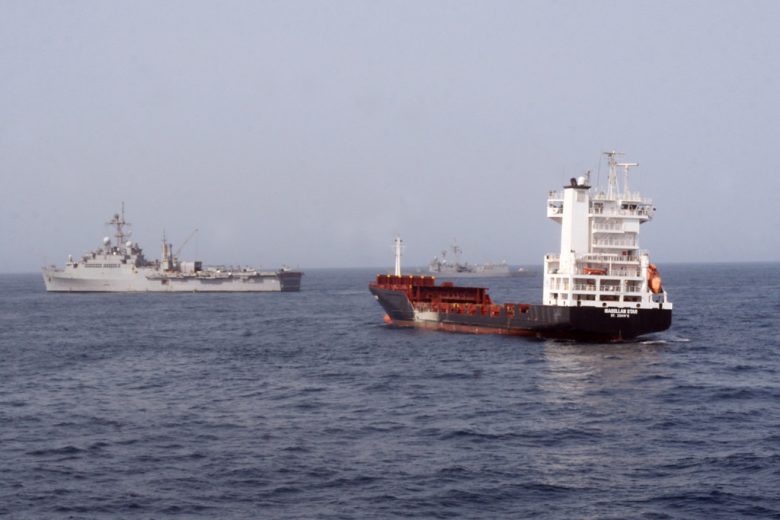
- The Strait of Hormuz carries roughly 20 percent of the world’s traded oil and 30 percent of globally traded LNG. Any sustained closure would constitute the largest energy supply disruption since the 1970s oil shocks.
- Iran has threatened Hormuz as a pressure lever but has not closed it, calculating that a full blockade would trigger military responses that dwarf anything already deployed.
- At the Trump-Xi summit on May 14, both leaders endorsed keeping the Strait open — the first joint US-China position on Iranian pressure since operations began in February.
When US and Israeli forces launched operations against Iran in February 2026, the immediate question was whether Tehran would respond by closing the Strait of Hormuz — the 33-kilometre-wide passage between Oman and Iran through which roughly 17 to 20 million barrels of crude oil transit daily. Three months later, the Strait remains technically open, but Iran’s mine-laying activities, harassment of commercial vessels, and deployment of fast-attack craft have pushed insurance premiums for tankers to levels not seen since the 1980s tanker wars.
The strategy has been described by analysts as “blockade diplomacy” — Tehran uses the credible threat of closure without executing it, extracting economic costs from global markets while preserving its deterrence. Brent crude has traded with unusual volatility since February, with swings exceeding $10 per barrel in single sessions driven by reported incidents in the Strait rather than fundamental supply-and-demand shifts.
Who bears the costs
China is the largest buyer of Gulf crude oil and therefore the most exposed major economy to a Hormuz disruption. That exposure is precisely what made the Trump-Xi summit’s Hormuz agreement significant: Xi Jinping’s endorsement of keeping the Strait open — and his expressed interest in purchasing more American oil to reduce dependence on Gulf shipping — represents a meaningful shift in Beijing’s public positioning toward the Iran conflict. China had previously offered diplomatic cover for Tehran; the Hormuz language is a different register entirely.
European importers face secondary disruptions. Several major tanker operators have rerouted ships around the Cape of Good Hope rather than risk the Strait, adding 10 to 14 days to voyage times and significantly higher fuel costs. The rerouting has absorbed spare tanker capacity globally, lifting freight rates and feeding into the energy-driven inflation that prompted the ECB to hold rates at its April 30 meeting.
The military picture
US and Israeli air and naval forces have degraded a significant portion of Iran’s surface-to-surface missile stockpiles and have targeted naval assets near the Strait. Iran’s ability to execute a full closure has diminished since February, but its capacity for harassment and mine warfare — cheaper, deniable, and highly disruptive — remains largely intact. The Iranian government has stated that any ground invasion or blockade of Iranian ports would trigger immediate closure of the Strait, a threat both Washington and Beijing appear to be taking seriously enough to avoid either option.
The equilibrium is unstable. A miscalculation — a tanker sinking, a naval confrontation that kills personnel from a non-belligerent nation — could shift the calculus rapidly. The fact that Trump and Xi agreed on Hormuz stability at their Beijing summit suggests both governments understand the stakes. Whether that shared understanding survives the duration of the conflict is the central question in global energy markets for the rest of 2026.